

The Story You Tell Yourself

Why the Human Brain Is Wired for Stories—and Why Seeing Yourself as the Hero of Your Own Adventure Might Change Your Life
A few weeks ago, I accidentally wrote my own origin story.
At least, that’s what I realized after finishing a blog post about my first ultramarathon, the Laurel Highlands 50K. I hadn’t set out to write a myth. I wasn’t thinking about Joseph Campbell, neuroscience, or narrative psychology. I simply wanted to capture what that race had meant to me.
If you haven't read it, stop reading this blog and read "The Laurel Highlands 50K and My Origin Story". Okay, Done? Then let's continue down this trail...
But when I stepped back and looked at what I’d written, I realized I hadn’t just produced a race report. I had unconsciously turned one hard day in the woods into a story about transformation: an ordinary runner entering unfamiliar terrain, getting humbled, suffering, adapting, and coming out the other side changed.
That realization sent me down a rabbit hole.

After 15 years as a race director and more than 20 years of trail running, I’ve listened to thousands of race stories. They unfold around campfires after the finish. They show up in lengthy race reports online. They emerge while shuffling down a trail with friends or over a beer after an ultramarathon. Even when someone is asked a simple question like “How’d your race go?” they almost never respond with mile splits and finishing times.
Instead, they say something like:
“Everything was going great until…”
Then comes the storm. The wrong turn. The bonk. The low point. The stranger who offered encouragement. The miraculous comeback. The finish line.
Without even realizing it, they’ve transformed a sporting event into a story.
Which raises an interesting question: why?
Why do we organize our memories into beginnings, setbacks, climaxes, and endings? Why do we instinctively narrate our lives around campfires today much like our ancestors did thousands of years ago? Why do trail runners, of all people, seem especially incapable of describing a race without turning it into a miniature epic?
The answer may be that storytelling isn’t simply entertainment. It’s one of the primary ways the human mind makes sense of the world.
Long before books, movies, podcasts, or social media, stories taught our ancestors which plants were poisonous, where danger lurked, how to cooperate, what courage looked like, and what kind of people they should aspire to become. Stories helped us remember. They helped us imagine. They helped us survive.
Modern psychology has arrived at a remarkably similar conclusion. Researchers in narrative psychology argue that we don’t merely tell stories. We use them to construct our identities. Neuroscientists have found that many of the same brain networks involved in remembering the past are also used to imagine the future. In many ways, our brains are constantly weaving experience into narrative.
Which leads to a fascinating possibility.
If stories shape how we understand our lives, then learning to tell better stories may not just help us become better writers or more entertaining company around a campfire. It may also change how we see ourselves.
And perhaps the most important story you will ever tell is the one you tell yourself.
Why We Can't Help Telling Stories
If storytelling were merely entertainment, it would be a curious coincidence that every culture on Earth from Arctic hunter-gatherers to ancient Greek philosophers to modern trail runners sitting around a campfire gravitates toward the same basic activity. We don't simply exchange information. We tell stories.
Modern psychology and neuroscience suggest that this isn't a cultural accident. Storytelling may be one of the primary ways the human brain understands the world.
Think about how someone describes an ultramarathon. They almost never begin with objective facts.
"The course was 63 miles long. I climbed 14,000 feet. I finished in 18 hours and 47 minutes."
Technically, that's information.
But it isn't a story.
Instead, they'll say, "Everything was going perfectly until mile 38..."
Instantly, your brain leans in. It wants to know what happened next.
That's because stories organize experience into something our minds instinctively understand: cause and effect, conflict and resolution, challenge and transformation.
![Marcy: So, for the sixth time in four miles, I had to go into the woods and hide behind a tree. [Nancy grinned even though the story was 'shitty'.]](https://static.wixstatic.com/media/8d1ff0_b2b0bf525fff481291d503dd58e24b22~mv2.jpg/v1/fill/w_980,h_653,al_c,q_85,usm_0.66_1.00_0.01,enc_avif,quality_auto/8d1ff0_b2b0bf525fff481291d503dd58e24b22~mv2.jpg)
We Become the Stories We Tell
Psychologist Dan P. McAdams has spent decades studying what he calls narrative identity. It is the idea that every one of us constructs an internal life story that explains who we are, where we've been, and where we're going.
Your identity isn't simply a collection of memories. It's your interpretation of those memories.
Imagine two runners who both miss a cutoff at the same race.
One tells himself, "I failed because I'm not cut out for ultrarunning."
The other says, "That race exposed weaknesses I need to work on."
The facts are identical.
The stories are completely different.
Research consistently shows that people who frame setbacks as chapters in a larger story of growth tend to report greater resilience, higher life satisfaction, and a stronger sense of purpose. In other words, we don't simply tell stories about our lives… we use stories to become the people we eventually are.
Facts Fade. Stories Stay.
Long before psychologists studied memory, storytellers understood something remarkable: facts fade, stories endure.
Cognitive psychologist Jerome Bruner argued that information becomes far more memorable when it is embedded within a narrative. Stories naturally provide the ingredients our brains crave: cause and effect, motivation, emotion, conflict, and resolution.
Compare these two lessons.
"Watch your footing on wet rocks."
Or...
"Remember Jim? He hit that slick boulder field, broke his trekking pole, and limped twelve miles to the next aid station."
Which one are you more likely to remember six months from now?
Probably the second.
Our ancestors understood this instinctively. Long before there were books or classrooms, cultures passed knowledge through myths, legends, and oral traditions. Stories helped people remember what mattered because stories made information meaningful.

Practice for Trouble
Stories don't merely help us remember. They help us rehearse.
Researchers studying mental simulation have found that when we read about someone climbing a mountain, escaping danger, or experiencing fear, many of the same brain systems involved in performing or feeling those actions become active. It's as though the brain partially experiences the event itself.
Reading isn't passive.
It's practice.
This may explain why stories are such powerful teachers. They allow us to experience triumphs and mistakes without paying the full cost ourselves.
You don't have to destroy your knee to learn that ignoring persistent pain is a bad idea. You hear the story of the runner who kept pushing despite every warning sign… and suddenly the lesson sticks.
Stories become a kind of virtual reality, allowing us to borrow someone else's experience before we face our own.

The Narrator in Your Head
Perhaps the most fascinating discovery comes from neuroscience.
When your mind appears to be doing nothing like when you're staring out the window during a long drive, sitting quietly beside a campfire, or hiking alone through the woods, a collection of brain regions known as the Default Mode Network becomes highly active.
Despite its name, this network isn't idle.
It's busy recalling old memories, imagining future possibilities, empathizing with other people, reflecting on who you are, and constructing the ongoing narrative of your life.
In other words, when your brain has nothing else demanding its attention, it often starts telling stories.
Not fictional stories.
Your story.
The one that explains your past, imagines your future, and quietly shapes the decisions you'll make tomorrow.
Campfires Were Our First Classrooms
If stories are so deeply woven into the human mind, where did this tendency come from?
One compelling answer comes from anthropologist Brian Boyd, who argues that storytelling evolved because it allowed humans to learn from imagined experiences instead of costly mistakes.
Instead of discovering that certain berries were poisonous by eating them yourself, you heard the story of the hunter who did.
Instead of learning that crossing a swollen river after heavy rain was dangerous through personal tragedy, you remembered the tale of the traveler who never returned.
Trail runners do exactly the same thing.
You don't have to suffer heat stroke to understand the importance of hydration. You don't have to ignore an injured knee to appreciate the consequences of pushing through the wrong kind of pain. Every finish line, aid station, and campfire becomes a place where hard-earned lessons are passed from one runner to another.
The details change. The purpose doesn't.
For tens of thousands of years, stories have functioned as humanity's oldest training manual. It’s a safe way to simulate danger, practice decision-making, and pass wisdom from one generation to the next.
Perhaps that's why stories have survived every technological revolution we've ever created.
They aren't simply entertainment.
They're one of the oldest survival tools our species has ever invented.
The Story Humans Keep Telling
If storytelling is woven into the human brain, another mystery emerges.
Why do stories separated by oceans, languages, religions, and thousands of years often follow remarkably similar patterns?
Why does Odysseus feel strangely familiar to Luke Skywalker? Why does Frodo resemble Harry Potter? Why does an Appalachian trail runner's race report echo themes found in ancient mythology? And why does Cheryl Strayed's memoir Wild feel less like a travelogue and more like a timeless quest?
Coincidence?
Or is there something deeper going on?
In 1949, mythologist Joseph Campbell proposed a fascinating answer in his landmark book, ‘The Hero with a Thousand Faces’. After studying myths, legends, and religious stories from cultures around the world, Campbell noticed a recurring pattern. Whether the hero was a Greek warrior, a medieval knight, a Buddhist pilgrim, or an ordinary person thrust into extraordinary circumstances, their journey often unfolded in remarkably similar ways.
He called this pattern the Hero's Journey, or the Monomyth.

At its heart, the Hero's Journey is deceptively simple.
Someone begins in the familiar world. Something disrupts that ordinary life. They hesitate, but eventually step into the unknown. Along the way they face trials, receive help from mentors and allies, confront their deepest fears, and ultimately return home transformed not merely with a prize, but with a new understanding of themselves.
Christopher Vogler later adapted Campbell's work into a twelve-stage framework that has become one of the most influential models in modern storytelling. While the individual stages have colorful names like The Call to Adventure, Crossing the Threshold, The Ordeal, Return with the Elixir, but they all describe the same fundamental process:
Leave.
Struggle.
Change.
Return.
If that sounds familiar, it's because you've probably lived some version of it yourself.
Consider Cheryl Strayed's memoir, “Wild”. On the surface, it's the story of a woman hiking the Pacific Crest Trail. But the miles are only part of the narrative.
Her ordinary world is shattered by the death of her mother. Unable to cope with grief, she spirals into addiction, infidelity, and divorce before discovering the possibility of redemption through an impossibly ambitious hike. The trail becomes her threshold into the unknown. Every blister, rattlesnake, snowstorm, and lonely campsite becomes another trial. Along the way she receives help from strangers, confronts memories she'd spent years avoiding, and slowly sheds not only the weight of her backpack but also the emotional burdens she has carried since her mother's death.
When Cheryl reaches the Bridge of the Gods at the end of the trail, she hasn't simply completed a long hike. She has become a different person. That's the Hero's Journey.
Notice that the destination isn't the point. Transformation is.

Campbell Didn't Pull This Out of Thin Air
Campbell didn't develop these ideas in isolation. He was deeply influenced by Swiss psychiatrist Carl Jung, whose work explored the hidden architecture of the human mind.
Jung believed that beneath our personal experiences lies what he called the collective unconscious: a shared psychological inheritance shaped by countless generations of human experience. Within it exist recurring patterns that he called archetypes.
These archetypes aren't specific characters so much as familiar roles.
The Hero.
The Mentor.
The Shadow.
The Trickster.
The Wise Elder.
The Mother.
Across cultures, these figures keep reappearing, wearing different names and faces but serving remarkably similar purposes. Campbell took Jung's psychological ideas and asked a natural question: if these patterns are deeply rooted in the human psyche, shouldn't they also appear in the stories humans tell?
He believed they do.
Whether you're reading Greek mythology, Norse sagas, Native American legends, African folklore, medieval epics, or simply listening to an ultrarunner recount the highs and lows of a hundred-mile race around a campfire, familiar characters and familiar moments often emerge. Someone offers guidance. Doubt creeps in. A seemingly impossible obstacle appears. The protagonist perseveres and returns changed.
The scenery changes.
Human nature doesn't.

Different Myths, Same Human Problem?
Campbell believed these similarities reflected universal psychological structures shared by all people.
Many modern scholars would phrase the idea more cautiously.
Perhaps stories resemble one another not because every culture inherited the exact same myth, but because every culture wrestles with the same fundamental questions.
How do we leave home?
How do we face fear?
How do we recover from loss?
How do we become adults?
How do we find purpose?
How do we endure suffering?
Every society answers those questions differently. Their heroes wear different clothes, speak different languages, worship different gods, and live in different landscapes.
But the underlying rhythm often feels familiar:
Someone leaves safety.
Faces uncertainty.
Learns.
Returns wiser.
That pattern describes mythological heroes, certainly.
But it also describes soldiers returning from war, immigrants beginning new lives, parents raising children, entrepreneurs starting businesses, students leaving home, cancer survivors rebuilding their lives, thru-hikers crossing continents, and ultrarunners discovering that the greatest challenge on race day isn't the mountain but it is themselves.
I don't believe this is because Campbell uncovered a single story that every human being is destined to follow. I think it's because human growth itself often follows that rhythm.

Not Every Trail Follows the Map
Campbell's work has been enormously influential, but it has also attracted thoughtful criticism.
Some scholars argue he overstated the similarities among world mythologies while overlooking important cultural differences. Not every culture celebrates the lone hero. Many traditions place greater emphasis on family, community, or collective responsibility. Others don't end with a triumphant return at all.
Others have suggested that Campbell sometimes selected examples that supported his theory while giving less attention to stories that didn't fit the pattern.
And, of course, real life is rarely as tidy as mythology. Not every challenge begins with a clear call to adventure. Sometimes life changes because of random accidents, unexpected illness, or circumstances entirely beyond our control. Some journeys never feel complete. Some endings never arrive.
These are fair criticisms. But they don't diminish what makes the Hero's Journey valuable.
Why This Old Map Still Works
I'm not arguing that every novel, movie, race report, or human life neatly follows Campbell's blueprint.
It doesn't.
What I am suggesting is that the Hero's Journey provides a remarkably useful lens through which to understand growth.
Because growth almost always asks something of us.
It asks us to leave what's familiar.
To face uncertainty.
To fail.
To adapt.
To pay a price.
And if we're fortunate, to return carrying something we didn't possess before—wisdom, resilience, humility, confidence, or compassion.
Those ideas don't belong exclusively to mythology.
They belong to being human.
And once you begin recognizing that pattern, you'll start seeing it everywhere from ancient epics to Hollywood films, from memoirs like Wild, to the race reports posted after every ultramarathon. The names and landscapes change. The journey, remarkably often, does not.
The Shortcut Hidden Inside Every Great Story (Through Multiple Dimensions)
Spend enough time around ultrarunners and you'll notice something peculiar. We don't just recount races… we perform them. Ask someone how their 100-miler went and they're unlikely to start with mile splits. Instead they'll begin with the moment everything changed.
"Everything was going great until..."
Then comes the crisis. The low point. The unlikely ally. The miraculous comeback. The finish line. Somewhere without realizing it, they've turned a sporting event into a myth.
That isn't an accident. It turns out human beings are astonishingly good at converting experience into stories because that's one of the primary ways our brains make sense of reality. If humans naturally think in stories, then it isn't surprising that storytellers across centuries have independently discovered similar structures. Joseph Campbell described the Hero's Journey. Christopher Vogler adapted it for screenwriting. And then Dan Harmon enters the chat. He simplified it into an elegant eight-step circle that works just as well for telling a race report as it does for writing an episode of “Rick and Morty”.
The Dan Harmon Story Circle, also known as “The Embryo”, is an approach to plotting developed by TV writer Dan Harmon of “Community” and “Rick and Morty” fame. It follows a protagonist through eight stages, beginning with the character being in their comfort zone, then venturing out into the unknown to seek something they want. The character achieves their desire, but at a great cost, and ultimately returns transformed by what they’ve experienced.
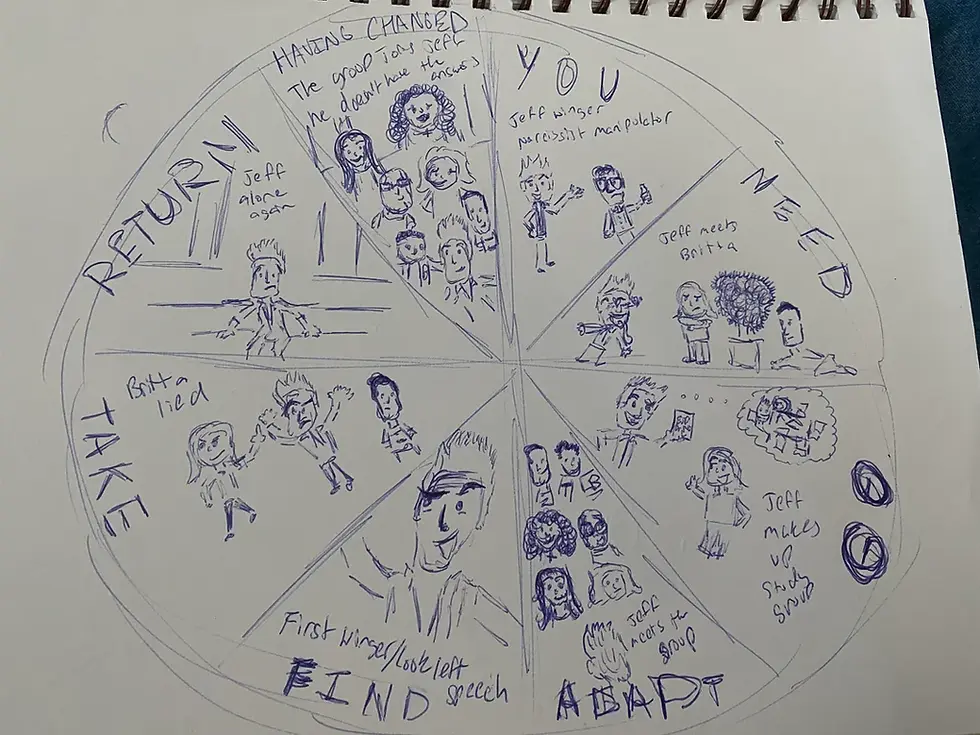
Harmon Hands You a Portal Gun (Compass)
This particular story structure is adapted from the monomyth, also known as “The Hero’s Journey” which itself derives from the work of academic Joseph Campbell, which I wrote about earlier, where characters are venturing out to get what they need, and Returning, having Changed.
The Story Circle functions similarly. So reader, you may ask, why not just use the original? In short, Campbell’s system is more complex and alludes to a particular type of story, namely high fantasy (think knights, wizards, potions, and swords in stones). What Harmon did was streamline this process to just eight steps, and broaden them out to be less genre specific. The benefit of Harmon’s version is that it focuses more specifically on character and is much easier to apply to a wider range of stories.
You might be asking why Harmon doesn’t just lay this structure out in a flat line. When asked about this, he points to the rhythms of biology, psychology, and culture as his inspiration: how we all move cyclically through phases of life and death, conscious and unconscious, order and chaos.
The fascinating thing he points out is that cycles like these are, in part, what have allowed humans to evolve.
“Behind (and beneath) your culture creating forebrain, there is an older, simpler monkey brain with a lot less to say and a much louder voice. One of the few things it's telling you, over and over again, is that you need to go search, find, take and return with change. Why? Because that is how the human animal has kept from going extinct, it's how human societies keep from collapsing and how you keep from walking into McDonald's with a machine gun.”
“We need [to] search — We need [to] get fire, we need [to find a] good woman, we need [to] land [on the] moon — but most importantly, we need RETURN and we need CHANGE, because we are a community, and if our heroes just climbed beanstalks and never came down, we wouldn't have survived our first ice age.”
What Harmon's getting at is that stories are a basic, universal part of human culture because of their millennia-long history as both a teaching and a learning tool. This idea of questing, changing, and returning is not a hack concept concocted by lazy writers, but an ingrained part of our collective psyche. That’s why stories from one culture are able to resonate with people across the world.
In Harmon’s philosophy, when a book, film, show, or song doesn’t meet the criteria above, it’s not necessarily bad writing: it’s simply not a story.
Out, Through, and Back Again
Now that we’ve got the background, it’s time to get into the meat: what are the steps of the Story Circle, and what do they entail.
Here are the Story Circle’s 8 steps:
A character is in a zone of comfort. Everyday life is mundane and unchallenging.
But they want something. The protagonist’s desire compels them to take action.
They enter an unfamiliar situation. The character crosses the threshold to pursue what they want.
Adapt to it. They acquire skills and learn how to survive in this new world.
Get what they wanted. The character achieves their goal, but at a cost.
Pay a heavy price for it. New and unexpected losses follow the victory.
Then return to their familiar situation. The character goes back to where they started.
Having changed. The story’s resolution; the lessons they’ve learned stay with them, and the character has grown.

I Accidentally Wrote My Origin Story
A few weeks ago I sat down to write about my first ultramarathon, the Laurel Highlands 50K. I wasn't thinking about Joseph Campbell or Dan Harmon. I simply wanted to tell the story honestly.
When I finished, I realized I'd unconsciously followed nearly every step of Harmon's Story Circle.
The realization surprised me.
I hadn't sat down to write a story. I wasn't trying to force my experience into some mythical template. I was simply describing what happened. Yet there it was! The same narrative rhythm that has appeared in stories for thousands of years.
It began with an ordinary marathon runner who wondered whether he belonged in this strange new world of ultrarunning.
That question (not the race itself) became the real story.
The Laurel Highlands Trail wasn't just another course. It was the threshold into unfamiliar territory. The smooth pavement I'd always known gave way to rocks, roots, relentless climbs, and long stretches of wilderness where every mile seemed determined to expose another weakness.
The trail had its own rules, and I didn't know any of them.
Somewhere along the way, though, something unexpected happened.
The person who started the race slowly disappeared.
I learned to move over technical terrain. I discovered that discomfort wasn't always a warning sign but was often simply part of the experience. Confidence replaced uncertainty, not because the trail became easier, but because I was becoming someone capable of meeting it.
Of course, every meaningful story demands a price.
Mine came through exhaustion, cramps, self-doubt, and those familiar internal negotiations that every endurance athlete eventually faces. The body wanted one thing. The mind wanted another. Every step forward had to be earned.
Eventually, civilization returned.
The finish line appeared. Friends. Volunteers. Applause.
The race was over.
Or so I thought.
Looking back now, I realize the finish line wasn't the ending of the story.
It was the beginning.
Crossing that line didn't simply make me someone who had completed a 50K.
It gave me a new identity.
After Laurel Highlands, I no longer wondered whether I belonged in ultrarunning. I was an ultrarunner. That single experience launched more than a decade of adventures across mountains with new races, longer distances, lifelong friendships, and eventually a life spent directing trail races and helping thousands of other runners begin journeys of their own.
That's what Dan Harmon understood.
The goal isn't the treasure.
The goal is transformation.
Every meaningful story begins with someone who wants something. Along the way they discover that what they truly needed wasn't the prize waiting at the end, but the person they had to become in order to reach it.
I thought I was writing about my first ultramarathon.
Instead, I had written my origin story.
Events don't change our lives. The stories we construct about those events do.
My Laurel Highlands 50K as a Story Circle
YOU | A trailrunner with a goal. | |
NEED | Prove I belongEnter the Laurel Highlands wilderness in this strange world of ultrarunning. | |
GO | Enter the Laurel Highlands wilderness | |
SEARCH | Learn the rules of the trail and of ultrarunning. | |
FIND | Discover unexpected strength and possibility. | |
TAKE | Pay the price through suffering, cramps, and doubt. | |
RETURN | Reach civilization and the finish line. | |
CHANGE | Leave not merely with a result, but with a new identity that launches the next decade of adventures |
The Story You Live
What if the stories we tell ourselves determine the lives we end up living?
When I realized I'd accidentally written my own origin story, another question occurred to me.
If I instinctively framed one of the defining moments of my life as a Hero's Journey...how many other people do exactly the same thing?
As it turns out… psychologists have been asking that question too.
Narrative psychologist Dan McAdams argues that every one of us carries around an internal autobiography.
It isn't perfectly accurate.
It isn't even finished.
It's the ongoing story we tell ourselves about who we are.
Every success.
Every failure.
Every heartbreak.
Every finish line.
We weave them into a narrative that explains our identity.
What's remarkable is that positive psychology has arrived at many of the same conclusions as mythology. Martin Seligman's PERMA model argues that flourishing isn't built from happiness alone.
It comes from five ingredients:
Positive emotions.
Deep engagement.
Relationships.
Meaning.
Accomplishment.
Read those again.
They almost sound like the Hero's Journey.
The Hero's Journey isn't a scientific model. PERMA isn't mythology. Yet they're strangely compatible. Heroes don't flourish because life is easy. They flourish because they pursue meaningful goals. They become deeply engaged. They rely on mentors and companions. They discover purpose. And in the end, they accomplish something that permanently changes how they see themselves.
Those are exactly the ingredients Seligman argues help people flourish.
Researchers have even developed something called the Hero's Journey Scale—a way of measuring the extent to which people interpret their own lives through themes like challenge, transformation, and growth.
The findings are fascinating.

People who naturally view their lives as heroic journeys consistently report greater life satisfaction, resilience, flourishing, and psychological well-being.
Every meaningful life eventually presents a call to adventure.
Sometimes it's exciting.
More often it's terrifying.
A diagnosis.
Losing a job.
Becoming a parent.
Signing up for your first ultramarathon.
You don't get to choose whether life changes.
You only get to decide whether you'll answer the call.
No hero succeeds alone.
Campbell knew it.
Harmon knew it.
Every ultrarunner knows it.
Behind every buckle are aid station volunteers, patient spouses, training partners, race directors, complete strangers handing you a cup of broth at 3 a.m., and friends who believed you could finish when you had stopped believing it yourself.
Maybe that's why we love stories. Not because they let us escape reality. But because they help us interpret it. Every one of us is already living a story. The only question is whether we see ourselves as the victim… or the protagonist.
Whether setbacks become endings… or merely the middle chapters. Whether we believe our best days are behind us… or that we're still somewhere in the second act.
Back to the Trailhead
Every ultramarathon I've ever directed has produced hundreds of stories. Runners usually think they're telling me about aid stations, climbs, blisters, and finish times. They're not.
They're telling me about leaving the familiar, confronting uncertainty, finding unexpected strength, paying a price, and returning changed.
That's why people lean in around campfires after races. They're not listening for split times. They're listening for transformation.
Perhaps that's because stories aren't simply entertainment. They are one of the oldest operating systems of the human mind.
And if that's true, then maybe the most important story you'll ever tell isn't your race report.
It's the one you tell yourself about your own life.
Every morning you wake up in an ordinary world. Every day offers a call to adventure, however small. Every setback is another trial. Every finish line is a return with something you've gained.
You may never slay a dragon or save a kingdom. But by choosing to see your own life as a meaningful journey, one that asks you to grow, suffer, learn, and return a little wiser, you become the protagonist of a story worth living.
Maybe that is why humans have always loved stories.
Deep down, we're not just looking for heroes.
We're looking for ourselves.
We spend our lives searching for great stories in books, movies, and around campfires after long days on the trail.
But perhaps the greatest story isn't one you'll ever read.
It's the one you're writing every day.
The story you tell yourself.


Comments