

The Megatransect: A Brief History of Questionable Decisions

My notes: In 2013, I signed up for the Megatransect with more enthusiasm than preparation and considerably less understanding of what “go light and fast” actually meant. What followed was 26-plus miles of boulders, creek crossings, questionable footwear decisions, and a steadily escalating argument between my ambition and my legs. The Megatransect is no more, but races like that have a way of sticking with you. More than a decade later, the event is gone, but the memories and the lessons remain.
There are races you sign up for because you have carefully considered the course, evaluated your training, examined your available equipment and concluded that you are adequately prepared for the challenge. Then there are races you sign up for because somebody says, "You should do the Megatransect," and you think, "Sure. That sounds reasonable."
The Megatransect was the second kind.
In 2013, I had been running trails long enough to have developed a dangerous amount of confidence. I had run ultras. I had directed races. I knew what a mountain looked like. I knew what a map was. I had even, on several occasions, successfully arrived at the correct trailhead without having to call anyone for directions. By the standards of Pennsylvania trail running, this qualified me as an expert.
The Megatransect takes place in Bald Eagle State Forest above Lock Haven and covers a little more than 26 miles, although describing it as a marathon is like describing a bear as a large dog. Technically correct, but missing some important information. The course features more than 5,000 feet of climbing, long descents, technical singletrack, jeep roads, stream crossings, waterfalls and several enormous boulder fields. The exact route changes every year, and the map is kept secret until race morning, which is a charming tradition if you enjoy discovering at 7:02 a.m. that the next four hours of your life are going to involve climbing directly up the side of Pennsylvania.
The race is part trail run, part expedition and part annual reminder that glaciers once had a very different vision for central Pennsylvania.
I decided to run it.
Naturally, I did this without really preparing.
The Winter of Disconnect
Registration opened at noon on January 1. There were 950 spots available, and the previous year's race had sold out in about 90 minutes. I was determined not to spend New Year's Day discovering that my trail-running ambitions had been defeated by a website.
At 11:58 a.m., still half-awake and nursing the remnants of a New Year's Eve hangover, I sat in my apartment with my iPad and credit card ready. At 11:57, I started entering my information so I could hit the button precisely at noon.
Then came the message:
Resource error.
I tried again.
Resource error.
Again.
Resource error.
The Megatransect website had apparently received the same New Year's resolution as the rest of us: become healthier, stronger and more miserable. The server was melting down under the combined weight of thousands of runners trying to register simultaneously. Somewhere, a server administrator was probably staring into the middle distance and reconsidering every decision that had led to this moment.
I went to the Mega's Facebook page and discovered that the server had crashed and was apparently melting a hole toward the center of the Earth.
My friend Brian Beiler was doing the same thing. I had somehow convinced Brian to run the race with me, mostly by telling him that if he wanted to do a tough race, this was the one to do. Brian had run several Spartan Races and had done very well in them, including one where he finished 13th in his age group, putting him somewhere in the top three percent.
After more than three hours of furious tapping on every internet-connected device we could find, we both got in.
We were officially Megatransect runners.
This was our first victory.
It would also be the last thing about the race that went according to plan.
Preparation, Such as It Was
By September, the Megatransect was approaching and I had begun to notice an unfortunate discrepancy between my confidence and my training.
I was directing Rock ’N The Knob, which consumed the usual amount of time associated with directing a trail race, meaning considerably more than the amount of time available in a human week. I had intended to get in a 30-mile training run after the race, but I got sick instead and managed an eight-mile hike. The following weekend I ran ten miles because I was trying to be responsible.
This was my preparation for a 26-mile mountain race.
There are moments in life when the correct response to your own behavior is to stop and reconsider your choices. I did not experience one of those moments.
My fall calendar was also beginning to resemble the work schedule of a person who had either developed an unusual enthusiasm for endurance sports or was being punished by a court. After the Megatransect, I was supposed to pace my friend Elmo Snively for roughly the final 37 miles of the Oil Creek 100. After that came the Sinnemahone 50K.
When I mentioned all of this to Elmo over drinks, he told me not to let my pacing responsibilities interfere with having a good race at the Mega. If I felt good, he said, I should run hard.
This was exactly the sort of advice I wanted to hear.
It was not necessarily the sort of advice I needed.
Then the elevation profile appeared.
The race directors had released enough information to show that a large section of the course was supposedly runnable. I asked about this and received the sort of answer experienced trail runners give when they know you are about to misunderstand something.
Yes, it was "runnable".
They put the word in quotation marks.
I ignored the quotation marks.

Four-time Megatransect veteran Mary Kowalski gave me the advice I should have remembered throughout the entire day: go light and fast.
Unfortunately, I heard "fast."
The word "light" apparently went through one ear, stopped for a beer, and never came back.
Race Morning
I slept badly the night before, which is how I generally prepare for important events.
My parents, my dad's Uncle Ted, who was visiting from Seattle, and I had dinner at The Wine Cellar in Gallitzin. I went to bed around 8 p.m. because I needed to wake up at 3:30. This would have been an excellent plan if sleep had been included.
Instead, I lay awake for most of the night.
At 3:30 I got dressed, walked toward the door and was backing out of my parents' driveway when my mother came running outside holding my wallet and cell phone.
"You forgot your phone and wallet!"
She was correct.
She also believed this represented a potentially life-threatening emergency.
I told her they weren't important.
They were, in fact, important.
This would later become part of the Mazur family historical record, in which my mother had personally saved my life before an ultramarathon.
I drove toward Hollidaysburg intending to stop at Sheetz for breakfast. It was too early for breakfast sandwiches, so I ordered one through the MTO system and then discovered that I was running late to meet Joel Noal.
I arrived at the wrong street.
I drove up and down the block several times looking for his house, increasingly reluctant to get out of my car because there had recently been stories about locals being shot for trespassing on private property.
Eventually I realized I was simply in the wrong neighborhood.
Joel and Nicole Claar were waiting for me on the correct street.
I was ten minutes late.
At that point, I had already forgotten my wallet, almost left my phone behind, gotten lost before sunrise and was now depending on people who were clearly more organized than I was to get me to a secret-course mountain race.
Things were going great.
The Start
When we reached the Castanea Sportsman's Club, I picked up my packet and finally got to see the course map.
I immediately ran into friends and familiar faces, including Luke Ebeling, who had recently run Rock ’N The Knob with a broken hand. Luke had fallen around mile two, finished the race anyway and eventually needed six screws to repair the damage.
He wasn't running the Megatransect. He had come to cheer.
This is an important distinction in Pennsylvania trail running. A normal person with six screws in his hand might spend the weekend recovering. A Pennsylvania trail runner uses the occasion to support participants in a trail race.
I asked Brian Newcomer (one of the race directors) about shoes. I had brought my Salomon Speedcross and Brooks Cascadias. Newcomer recommended the Cascadias because the Tuscarora sandstone was grippy and the wet rocks should dry out before I reached them.
This was one of the few pieces of advice I followed exactly.
Joel was faster than me. This was not surprising. Joel is one of those runners who makes you feel inadequate simply by looking at his runs on Strava. Yet, today, he wasn't running his own race. He had received a bib from Nicole's father, who had broken his foot.
This was 2013, when race-bib transfer ethics were apparently still governed by the same legal principles as trading baseball cards.
As the start approached, I couldn't find Brian Beiler. I called him. No answer.
I went to Joel's car and prepared my nutrition. I had two bottles, one with Perpetuem and one with Gatorade, a handheld bottle containing Hammer Gel mixed with water, Clif Minis and GU blocks.
In other words, I had plenty of food.
I would later demonstrate that having food and actually eating food are two completely different skills.
I walked toward the start and found myself standing near the front of the field with runners like Mary Kowalski and Jeff Calvert.

This was not because I belonged there. I had simply wandered into the wrong place.
The race director started counting down.
Five.
Four.
Three.
I pulled out my iPhone to start my GPS.
Two.
The phone was locked.
One.
I was trying to remember my new passcode while hundreds of people began running around me.
Then the phone rang.
It was Brian. At the exact moment the race started.
I stepped aside to answer him, tried to start the GPS, and discovered that the cable connecting my phone to my backup battery had somehow come loose.
My battery had fallen out of my belt.
I picked it up.
The cable was gone.
Someone running past said, "Hey, buddy. You dropped something back there."
I eventually got the phone working, shoved everything back into my belt and started running.
I was angry.
I was rattled.
And because nothing improves a 26-mile mountain race like being emotionally agitated at the starting line, I ran the first three miles in 8:35, 8:10 and 7:57.
The Megatransect had begun.
My quads were not yet aware that they had been drafted into a war.

Spartans Run the Hills
The first several miles were pavement and road, leading away from the airport and through Castanea toward the mountain. I looked down from a cloverleaf and saw hundreds of runners behind me.
That made me feel better.
It also reminded me that Brian was somewhere back there.
Eventually I caught Joel and Nicole and told them I hadn't been able to connect with Brian. Then, somewhere along the road, I heard someone shout my name.
It was Brian.
He had been trying to catch me.
We ran together toward the mountain, and I asked him how he was doing on hills.
"Spartans run the hills," he said.
What the fuck does that mean?
We turned onto a dirt road, and then Brian stopped to get his MP3 player working. Since it was back in the olden times sans Bluetooth, he spent what seemed like an eternity threading wires through his shirt like a marionette, arranging the earpieces, and prepared to disappear into his own personal soundtrack.
I noticed his ankles were taped.
"Why are your ankles taped?"
He couldn't hear me.
I ran closer.
"Why are your ankles taped?"
"What?! I can't hear you! My music! It's too loud!"
I groaned.
I tried again.
"Why are your knees taped?"
"Just a preventive measure."
"Are you ready to do this?"
"Ready. Hoo-rah!"
Off we went.
This was the beginning of the part of the race where the civilized world gradually disappeared.
Link Trail
Link Trail climbed about 800 feet in less than a mile, with some grades reaching more than 30 percent.
I like climbing.
This was my moment.
I passed people whenever I could.
Strava's Grade Adjusted Pace told me that my 16:05 actual pace was equivalent to about a nine-minute pace on flat ground. I did not understand the mathematics, but it sounded like I was doing well.
Brian was keeping up.
Then the trail turned downward.
Downhill running has never been my greatest talent. Some runners descend steep technical trails with the loose confidence of people who have been shot out of a cannon. I descend like a man who has read the liability waiver.
Still, I followed another runner who was finding good lines through the rocks and started moving faster.
We passed a dozen people.
My quads were beginning to complain.
I ignored them.
This is an important ultrarunning technique. You identify an obvious warning sign, decide it is probably nothing and continue until the warning sign becomes a problem that can no longer be ignored.
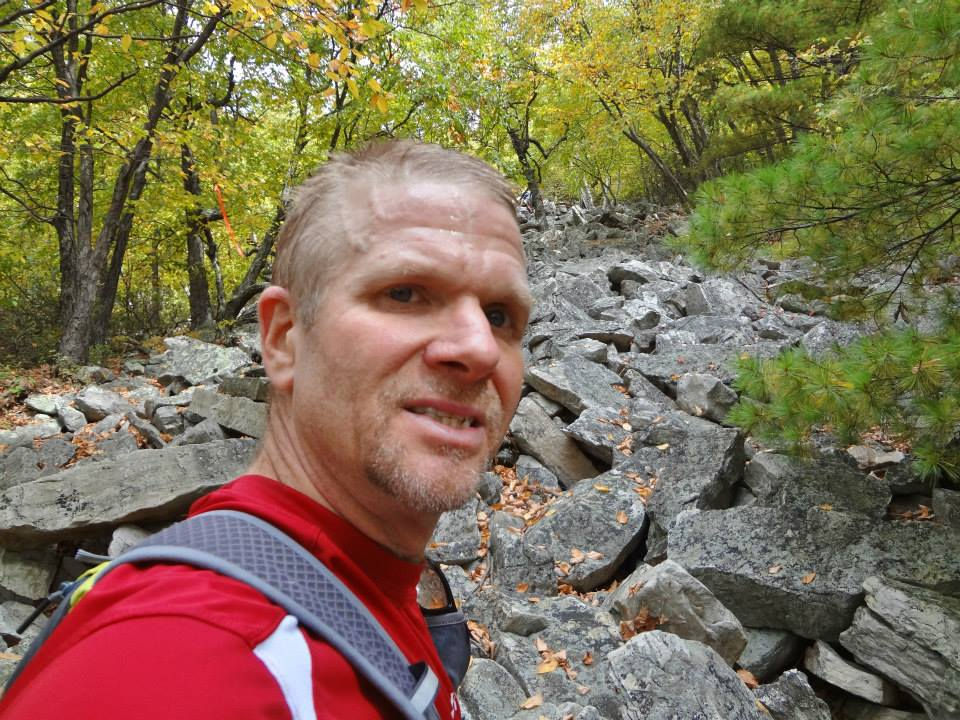
Then came the Boulder Field.

The forest opened and the mountain was suddenly covered with enormous Tuscarora sandstone boulders, stacked across the slope like someone had dropped a shipment of Pennsylvania on the ground and decided not to clean it up.
There are very few times in a trail race when you encounter something so visually overwhelming that the race temporarily stops feeling like a race.
This was one of those times.
"The moon called. They want their rocks back."
I attacked the Boulder Field.

The rocks were much more manageable than they appeared. The sandstone was remarkably grippy and most of the boulders were firmly wedged into place. The trick was finding the right line. I worked left, then back toward the center, winding through the field and eventually running a section of 75 to 100 yards.
"Show off!" someone yelled.
It was Janine Gusztaw.
I was delighted.
I had found my people.
The Boulder Field climbed about 630 feet in less than half a mile. I got through it in roughly 16 minutes.
I looked back twice.
I should have looked more.
The view over the Bald Eagle Valley was disappearing into the morning fog, and yey the whole thing was spectacular. The mountain was ancient and indifferent, which was appropriate because they were about to become considerably more important to my day than I had anticipated.

The Runnable Trail
At the top, the trail was rocky but runnable.
This was the first time I understood what the race directors had meant.
"Runnable" did not mean "easy."
It meant you could run between the rocks.
You still had to watch every foot placement, pick your lines, negotiate roots and avoid turning an ankle because you got distracted by something interesting.
I passed people and heard a father and daughter I know running behind me. I never looked back. On technical trails, you eventually learn to identify people by their voices.
Then I rounded a corner and encountered a man urinating directly in the trail.
"What are you doing? Marking the trail?"
He didn't laugh.
He was wearing a greenish-yellow Team General Electric shirt, which seemed like a perfect opportunity to ask whether this was some sort of sadistic corporate wellness initiative.
He explained that he wasn't actually a GE employee. He had joined their adventure team for the race and had been doing the Mega for four years.
Fair enough.
I moved on.

The trail became Rattlesnake Ridge, then Winchester, which dropped roughly 700 feet in less than a mile.
I had fun descending it.
This was probably because I had temporarily lost contact with the portion of my brain responsible for self-preservation.
At the bottom, we hit Kammerdiner Road, a dirt jeep road covered in rocks. Somehow I ran an eight-minute mile.
By this point, my quads were no longer merely complaining.
They had retained counsel.
The First Aid Station
At about nine miles, I started looking for the aid station.
It wasn't there.
I was running low on fluids and, more importantly, I realized that I had eaten almost nothing.
Normally I set my watch to remind me to eat every 30 minutes.
For this race, I had decided I would simply try to remember.
This is an excellent example of the human brain's capacity to make a problem more complicated than necessary.
I had no problem remembering that I was tired.
I had no problem remembering that I was thirsty.
I had no problem remembering every profanity I had ever learned.
But somehow I couldn't remember to eat.
At the bottom of Kammerdiner I found a guy on a four-wheeler with a cooler.
"Is there beer in that cooler?"
"Perhaps."
"I may come back."

I continued toward Crossline Trail, which climbed roughly 625 feet in a mile.
Finally, at mile 10.25, I reached an aid station. Ashley Moyer was volunteering. I recognized her from the local trail-running scene and immediately became more interested in impressing her than in solving the nutritional crisis I had created for myself. She filled one bottle with Gatorade. I mixed Perpetuem into the other. I ate some gummy fish and headed back out.
The next section was supposed to be easy.
Dug Road.
Area 51.
EZ Rider.
Runnable.
I was about to discover that "runnable" is a relative term.
After 160 minutes of climbing and descending, my legs had begun to question the wisdom of running at all.
I told them to shut up.
They complied temporarily.
The Gorge
The course dropped toward McElhattan Creek and into a canyon that immediately made the entire race worthwhile.
The trail followed ledges above the valley before dropping through the gorge. There were stream crossings, rocky sections and a waterfall that looked like it had been transported from a rainforest and deposited in Clinton County by mistake. One stream dropped over the falls while another tributary cascaded down smaller ledges nearby.
This was one of the moments when I should have stopped and taken everything in. Instead, I kept racing.
That is one of the peculiar things about endurance sports. You can spend six months looking forward to a single day in the mountains, finally arrive in the middle of one of the most beautiful places you've ever seen, and then spend the entire experience thinking about your overall time.
We climbed out of the gorge and reached another aid station beside a lake.
I was sore.
I ate salty pretzels.
Then I used the port-a-john.
At that point, a giant box where you shat and pissed represented the pinnacle of Western civilization.
The Feet Revolt
Rim Trail followed the edge of the canyon, with the trail dropping away to one side. I was running with a small group when I noticed my feet.
The bottoms were getting hot.
I had never needed to lubricate my feet before a race. I had always considered foot care something other runners did because they were apparently made of delicate materials.
I had originally planned to wear my Salomons, which had a tight toe box, so I had chosen thin socks.
Then I switched to the Cascadias.
This is the sort of mistake that seems insignificant at home and becomes a major strategic decision after several hours of running.
The course eventually reached Gorge Trail, where we crossed the creek.
Then crossed it again.
And again.
There were five or six crossings, and the water was freezing.
By that point, my feet were already wet, so I stopped caring.
The father and daughter I knew caught me again.
At the bottom I stopped and retied my shoes, tightening every lace from bottom to top.
Miraculously, it worked.
The rubbing stopped.
My feet were fine.
I had solved a problem.
This should have made me suspicious.
Giant Steps
The Giant Steps were another one-mile climb, rising more than 600 feet through a V-shaped hollow and another boulder field.
This was not a gentle climb.
The rocks forced everyone into the bottom of the hallow, and some of the steps were high enough that getting over them required hauling your entire body upward.
A group of us moved together.
One runner announced, "After this I'm done with trails!"
Behind me, the father and daughter discussed vacation plans. There is something profoundly strange about listening to people discuss travel arrangements while you are simultaneously trying to climb over a boulder the size of a washing machine.
Eventually I moved into the lead.
For about 50 yards.
Then another runner passed me.
We all walked.
Eventually the grade eased and we began running again toward the aid station.
When we arrived, I realized the eight-mile loop had taken me about an hour and 50 minutes.
I was now at mile 18.6.
I was also finally confronting the fact that I had not eaten nearly enough.
I tried to eat a PB&J. My stomach regarded this suggestion as hostile.
The problem with not eating during an ultramarathon is that eventually you become too tired to eat, which makes you more tired, which makes you less interested in eating, which makes you more tired.
This is known in scientific circles as "the stupid spiral."
I was deep inside it.
The Pines
After leaving the aid station, I found a beautiful stretch of pine forest.
Tall trees rose straight into the sky. Yellowing ferns covered the ground. The trail was soft with pine needles and mostly free of rocks.

It was the sort of trail that makes you remember why you run.
My entire body hurt. My legs were sore. My core was sore. My ankles were sore. My feet were sore.
Everything below my neck had apparently resigned.
For a minute I stopped emotionally rather than physically. I wanted to keep running because this section was too beautiful to walk.
"Give me a moment," I said to myself.
Then, about a minute later, I said, "Okay. Time to man up."
I started running.
My shoelace came undone.
I bent over to tie it.
My legs cramped.
This was becoming a comedy in which the only audience was the forest.
I stood back up and decided I would find a log before tying the shoe again.
Eventually I reached Rote Trail and one of the great overlooks of the course. A group of college-aged runners had stopped to look out over the valley.
I wanted to stop too.
I didn't.
I was afraid that if I stopped moving, my legs would interpret it as retirement.
So I kept going.
Raw Trail
The course eventually turned onto a singletrack trail running through a mountain pass.
Then I saw another boulder field.
This one was steep.
This one was jagged.

This one appeared to have been constructed specifically to punish people who had made poor decisions during the previous 20 miles.
"Fuck me! God damn son of a bitch!", I yelled. Then I climbed.
The field rose only about 600 feet over 0.4 miles, but at that point in the race the mountain had ceased to be measured in feet.
It was measured in acts of betrayal.
I climbed one ridge and discovered another.
Then another.
Then another.
Every apparent summit was a lie.
At the top, several other runners arrived around the same time.
One of them asked if I was cramping.
"Big time."
He handed me four salt tablets.
Then he passed me.
Then several other runners passed me.
I waited for the cramps to ease and started down.
The descent was steep enough that every step became an experiment. I shortened my stride, changed my cadence, shifted my weight and did whatever I could to prevent another muscle from locking up.
This was no longer running.
This was diplomacy.
I was negotiating a cease-fire between my brain and my legs.
Eventually I reached the familiar trail from the beginning of the race.
A runner in front of me said, "Never in my entire life have I ever wanted to be back on a paved road."
"No kidding," I said.
We continued downward.
The Road
When the pavement appeared, I nearly cried.
There are few things more beautiful than a paved road when you have spent six hours being battered by rocks.
I ran through Castanea, where a family stood beside the road cheering runners.
The father looked at me.
"That guy looks tired."
"No shit, Sherlock!"
It came out before I could stop it.
His wife and children looked horrified.
I felt bad.
My legs hurt.
My brain was tired.
My social filter had apparently been left somewhere around The Giant Steps.
Then came the Green Mile.
It wasn't actually a mile. It was closer to 1.2 miles of grass along Route 220 and a fence.
It looked harmless.
At this stage of the race, nothing was harmless.
Runners around me were slowing down. Some were walking. I kept running.
Then a runner in an orange shirt caught me.
His name was also Benjamin.
"You are doing great! We have 20 minutes to get under seven hours. We can do it!"
I hadn't looked at my watch in hours.
Apparently I was still in position to break seven hours.
Benjamin and I started leapfrogging each other.
He would pass me.
I'd catch him.
He would slow.
I'd move ahead.
"Don't quit now!" he would yell.
"Come on!"
We continued this strange partnership all the way to the road.
Then under the highway.
Then across the railroad tracks.
The railroad ballast formed a small hill that felt like Mount Everest.
Then through the field.
Left.
Gradual hill.
Down toward the finish.
We had more than four minutes.
6:55:58
I crossed the finish line in 6:55:58, 115th overall, 99th male and 33rd in my age category.
I had guessed I might finish around 100th.
So, from a purely numerical standpoint, I had more or less accomplished what I set out to do. From a physical standpoint, I had been dismantled. Below the waist, I was a disaster. Above the waist, I felt pretty good. My body had apparently been divided into two separate governments, one of which had declared bankruptcy.
So, from a purely numerical standpoint, I had more or less accomplished what I set out to do.
From a physical standpoint, I had been dismantled.
Below the waist, I was a disaster. Above the waist, I felt pretty good. My body had apparently been divided into two separate governments, one of which had declared bankruptcy.
I collected my medallion and kept walking because stopping seemed dangerous.
For the next 30 minutes, I wandered around the finish area, walked back toward the course to cheer for runners, returned to the festival area and wandered some more.
Eventually I found the missing cable from my battery backup lying in the grass.
Of course I did.
The cable had completed its own Megatransect.
I met up with Mary, Jeff and some other friends. I ate chicken and pizza while waiting for Joel and Nicole.
They finished about an hour after me.
Beiler came in roughly 30 minutes after that.
He threatened me. Specifically, he made it very clear that I should never again ask him to run a race like this. This was fair. I had recruited him into the event, then immediately sprinted away from him because I claimed my phone was having an existential crisis.
The race itself had been faster than previous editions, but it was not easy. The course's increased runnable sections had simply shifted the difficulty around. Instead of crawling through technical terrain for the entire day, we had spent more time running, which meant more time running fast.
The mountain had not become easier.
We had simply found a more efficient way to suffer.
The Lesson
The next several days were spent discovering whether I had permanently damaged myself.
Sunday and Monday were unpleasant. I warned Elmo that I probably wouldn't be able to pace him at Oil Creek and suggested that Jeff Calvert might be willing to take over.
From Sunday through Wednesday, I took two- or three-mile walks every evening.
By Wednesday, most of the soreness was gone.
Thursday I ran three and a half miles at about a nine-minute pace.
I still wasn't ready to pace Elmo, and Jeff ended up doing a stellar job.
By Saturday, I was back out for an 11-mile hilly run.
Then came Sinnemahone.
Looking back, the most important lesson from the Megatransect wasn't about fitness, shoes, nutrition or even pacing. It was about understanding the difference between knowing something and actually understanding it.
Mary had told me to go light and fast.
I understood the words.
I did not understand the sentence.
The Megatransect was not a 26-mile race with some hills thrown in. It was a constantly changing mountain environment. You climbed, descended, scrambled, ran, hiked, crossed streams, negotiated rocks, changed your stride and made thousands of small decisions with your feet. The terrain dictated the pace, not the other way around.
I spent the first half of the race trying to make the mountain conform to my idea of what a good race should look like.
The mountain declined.
It had seniority.
It had been there considerably longer than I had.
By the second half, I was simply trying to work with it.
That turned out to be much more enjoyable.
The Megatransect was spectacular. The Boulder Field was ridiculous. The waterfalls and gorge were beautiful. The pine forest was one of those stretches of trail that makes you understand why people voluntarily spend their weekends getting lost in Pennsylvania. I got to run with friends, meet people I had only known by reputation, receive emergency salt tablets from a stranger, discover that a port-a-john can become a cherished destination and learn that my mother was, technically, correct about the importance of a phone and wallet.
I also learned that there is a fundamental difference between being prepared for a race and being confident that you will be fine. The former requires planning. The latter requires a suspicious lack of imagination.
I also learned that there is a fundamental difference between being prepared for a race and being confident that you will be fine.
The former requires planning.
The latter requires a suspicious lack of imagination.
I had plenty of the second.
Fortunately, I had just enough of the first to get me to the finish.
And somewhere along the way, I finally figured out what Mary meant.
Go light.
Go fast.
And, perhaps most importantly, listen to the people who have already been punched in the face by the mountain.
They know things.


Comments