

The Eastern States 100: Ten Things You Should Know About the Race Everyone Suddenly Seems to Be Talking About

A Rocksylvania Dispatch from the Pine Creek Valley
The Eastern States 100 has always been a little different: a brutally beautiful 103.5-mile journey through the Pennsylvania Wilds, a roughly 50% historical finish rate, world-class competition, and a grassroots, volunteer-powered organization rooted in the communities and history of the Pine Creek Valley. Following Kaylee Frederick's record-setting overall victory in 2026, we take a closer look at what makes Eastern States so difficult, why the weather is only part of the challenge, the importance of qualifying, and the people who make this race possible. Then we look ahead to August 14, 2027, when Eastern States returns for another round.
And just like that, another Eastern States 100 is in the books.
Except this year, it seems like a whole lot more people are paying attention.
Kaylee Frederick stole the show.

Frederick won the race outright in 23:09, setting a new women's course record and becoming the first woman in the race's 10 runnings to break the 24-hour barrier.
And she didn't merely win.
She crossed the finish line more than 90 minutes ahead of the next finisher.
Let that sink in for a minute.
A woman won one of the toughest 100-mile races in the East outright.
Last year's winner, Justyna Wilson, returned to take second female and fourth overall in 24:45, now the third-fastest women's time in Eastern States history. Marissa Kovach rounded out the women's podium in 27:51.
On the men's side, Francis Daley took the win and finished second overall in 24:40. Just four minutes later, Gabriel Batdorf came through in 24:44 for second male and third overall. Justin Demurias was the third male and fifth overall in 26:07.
So, yes.
There were some pretty spectacular performances at Eastern States this year.
But then there were the other 260-some stories.
We have 123 official finishers from 268 starters. That number also tells you something important about Eastern States.
Finishing is not guaranteed.
And that is probably a good place to start explaining what this race actually is.
Because with the recent media attention, Kaylee's remarkable finish, and Eastern States suddenly appearing in social media feeds belonging to people who have apparently never heard of Pine Creek before, I suspect we're going to have some new folks wandering into the Eastern States rabbit hole.
Welcome.
Grab your choice of beverage.
We've got some explaining to do.

Ten Things You Should Know About the Eastern States 100
1. It's not really a 100-mile race.
It's 103.5 miles.
Because apparently 100 wasn't enough.
Eastern States is a single-loop course through the Pine Creek watershed in the Pennsylvania Wilds, covering approximately 103.5 miles and roughly 21,000 feet of climbing and descent.
And that isn't 21,000 feet of nice, gradual mountain climbing.
This is Pennsylvania.
We have rocks. We have roots. We have steep climbs. We have steep descents. We have technical trail, old logging roads, hollows, ridgelines, abandoned quarries, creek crossings and enough terrain variety to keep your feet, brain and cardiovascular system engaged for approximately a day and a half.
The course travels through some of the most rugged and remote trail country in the Mid-Atlantic.
It is beautiful. It is historic. It is occasionally spectacular.
And it is, at times, an absolutely miserable place to be running at 3:17 in the morning.
We like to call it graduate-level trail running. There is a reason for that.
Eastern States isn't supposed to be easy.

2. About half the people who start don't finish.
This is probably the statistic that gets the most attention. Eastern States has historically hovered around a 50% finish rate.
This year we had 123 official finishers from 268 starters—about a 46% finish rate.
That means the DNF rate is roughly 54%.
We aren't hiding that number. We're not putting it in 6-point type at the bottom of the brochure.
We're actually telling you.
About half of the people who start Eastern States don't finish Eastern States.
There are races where that statistic would cause a marketing department to have a small nervous breakdown. We're not particularly interested in having that meeting. Eastern States isn't designed to manufacture finishers. It's designed to provide a legitimate, challenging 100-mile experience.
Sometimes you finish.
Sometimes you don't.
Sometimes you learn something.
Sometimes you learn several things, none of which are suitable for publication.
That's ultrarunning.

3. The weather matters. A lot.
Eastern States happens in August. In Pennsylvania. In the mountains. Which means heat and humidity are not bugs in the system. They're features.
We've had beautiful race weekends. We've had brutally hot race weekends. We've had humidity, storms, mud, wet rocks, dry rocks and pretty much every combination of weather that Pennsylvania can throw at us in August.
And weather absolutely plays a major role in the outcome.
But it isn't the only reason people DNF.
The terrain matters. The elevation matters. Nutrition matters. Hydration matters. Pacing matters. Sleep deprivation matters. Your feet matter. Your mental state matters. The decisions you made during the first 50 miles matter.
And, eventually, the fact that you have already run 80-some miles through difficult terrain starts to matter quite a bit.
Eastern States is hard because of the combination.
Weather is simply another member of the committee trying to ruin your weekend.
4. You actually have to qualify.
Eastern States is not designed to be somebody's first ultramarathon.
Our current qualification requirement is at least one officially organized 50K trail race or longer within the qualifying period. That's intentional.
We want participants to arrive with some experience in trail racing, aid stations, pacing, nutrition, terrain and the general concept that running for many, many hours can sometimes become uncomfortable.
This isn't about creating an elite club. It's about preparedness.
There is a big difference between thinking, “I could probably run 100 miles,” and actually having some experience with what happens to your body and brain after 22, 30 or 36 hours on your feet.
We'd rather you discover that during a 50K than at mile 72 of Eastern States.

5. It is a world-class race operated by a grassroots, not-for-profit organization.
This is probably the thing I'm most proud of. Eastern States has developed into a race capable of attracting some seriously talented athletes.
The performances we're seeing now are world-class. The competition is getting deeper. The course records keep getting faster. The race is getting national and international attention.
And yet the organization behind it remains a 501(c)(3), volunteer-driven, not-for-profit organization. There is no corporate running conglomerate behind Eastern States. There isn't a private equity firm wondering how we can improve shareholder value by raising the price of your buckle. There isn't a marketing department trying to determine whether “21,000 feet of climbing and a 50% finish rate” is a strong enough brand proposition.
There are volunteers. Lots of them. There are race directors, aid station captains, trail workers, medical personnel, communications people, logistics people, local first responders, photographers, contractors, land managers and an enormous number of people who simply care enough about this race to give up a weekend (and most times considerably more) to make it happen.
That's Eastern States.
World-class competition.
Grassroots soul.
And absolutely no desire to become something it isn't.
6. The local community isn't just where we hold the race. It's part of the race.
This is easy to overlook when you're looking at a course map.
Pine Creek is not just a pretty blue line running through the middle of the race. There are communities here.

People live here. People work here. People own businesses here. People volunteer here. People provide emergency services here. People have families here.
And every August, several hundred runners, hundreds of volunteers and a small traveling circus of race infrastructure descends upon the region.
We don't take that lightly.
The hospitality we've received from the communities throughout the Pine Creek Valley is one of the things that makes Eastern States special.
These communities don't simply tolerate the race. They help make it possible.
That relationship matters. Because we don't want to be the race that shows up, uses the place and leaves.
We want to be good guests.
7. You're running through history.
Eastern States is not a course manufactured for the sole purpose of putting 100 miles on a GPS track.
The landscape you're running through has a history that predates ultramarathons by quite a bit. Pine Creek and the surrounding mountains were once at the center of Pennsylvania's enormous lumber industry. Logging camps, railroads, timber operations, quarries and communities shaped this landscape.
The remnants are still there. Old roads. Railroad grades. Industrial remnants. Historic communities. Former logging routes.
Trails that have evolved from the infrastructure and transportation corridors of another era. You're running through a landscape that helped build Pennsylvania.
And sometimes, when you're crawling up a mountain at mile 91, you may find yourself wondering why our ancestors didn't simply decide to build everything somewhere flatter.
But that's part of what makes Eastern States interesting.
You're not just running through the woods.
You're running through the history of the woods.

8. The scenery is spectacular. You may not notice all of it.
This is one of the great ironies of trail running. We put a beautiful course together. You spend hours running through spectacular Pennsylvania wilderness. We provide incredible views. And somewhere around mile 76, you're staring at the ground thinking: “If I fall down right here, I can just live here now.”
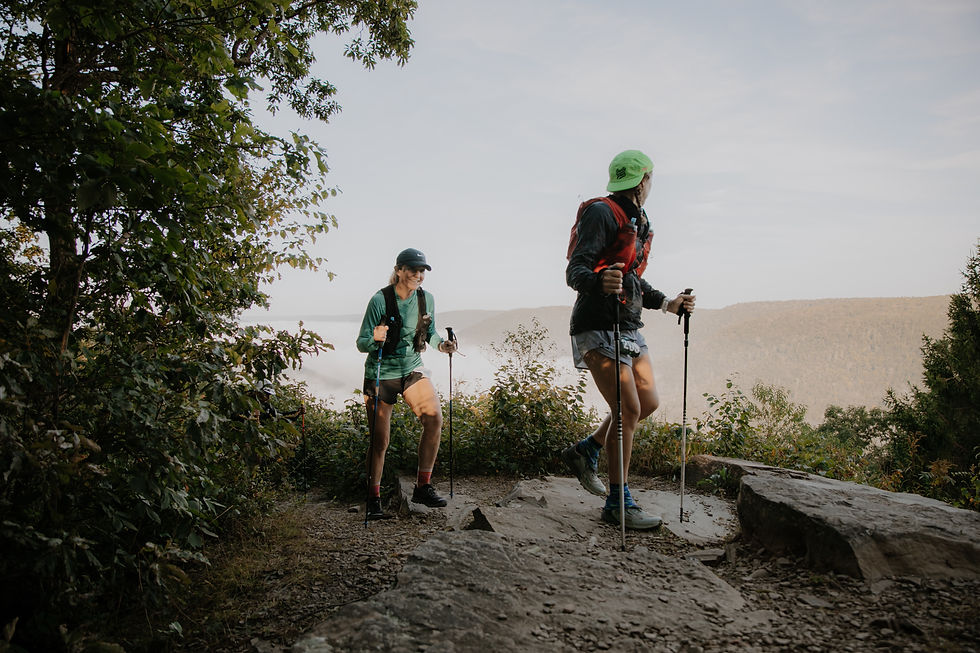
The Pine Creek watershed is one of the most spectacular landscapes in Pennsylvania. Deep valleys. Mountain ridges. Forests. Rock formations. Streams. Waterfalls. Wildlife. Long views across the PA Wilds.
There are sections where you can stop, look around and understand exactly why people love this place. And then there are sections where the trail turns upward and you understand why approximately half of the entrants won't be getting a buckle.
Both things can be true.
9. The volunteers are the real race.
Eastern States doesn't happen because somebody drew a line on a map. It doesn't happen because of the start or finish line. And it certainly doesn't happen because a bunch of runners decided they wanted to run 103 miles. It happens because an army of people decides, year after year, that making this thing happen is worth the effort.
To our race staff, who somehow keep the whole machine moving. To every aid station volunteer, serving food, water, encouragement, questionable advice, and occasionally the emotional support required to convince someone that continuing into the Pennsylvania night is still a good idea.

To our battle-hardened logistics crew, trail workers, local first responders, communications team, medical personnel, and all the people whose jobs are rarely visible but absolutely essential.
To our contracted professionals—from race support to our uber-talented photographers—who bring expertise, professionalism and, thankfully, fewer problems than the rest of us.
To our partners at the Pennsylvania Department of Conservation and Natural Resources, the Game Commission, local and regional municipalities, and all the other agencies and organizations that help us navigate the considerable machinery required to put 100 miles of organized chaos through the woods.
The list is long.
And, appropriately, so is the amount of gratitude.
10. And finally: Eastern States is about people.
This is the part that gets lost when we talk about finish times, course records, qualification standards and DNF percentages.
The numbers are only part of the story.

Pretty much every participant I encountered, at least those who were still coherent, or had become sufficiently overcome by all the feels, wanted to express their appreciation for the event and the people who made it happen.
So let me pass that along.
Thank you.
Thank you to every participant, regardless of outcome, who stood on that start line and decided to find out just how far your feet, your resolve and a little bit of fate could carry you.
This is my 15th year directing races and my fourth year directing Eastern States. You can't help but become invested in the people who show up for something like this. I know many of you personally.
And for those I don't, I still know there is a person behind every bib number. There is a person with a history, hopes, hard work, fears, expectations and a whole lot of hope tied up in those three digits.
Some of you got the buckle.
Some of you didn't.
Some of you set records.
Some of you discovered that 100 miles is, in fact, a really long way.
Some of you made it farther than you ever thought possible.
Some of you stopped because your body told you to.
Some of you stopped because the clock told you to.
Some of you probably stopped because your brain finally filed a formal complaint.
Yet all of you left something out there.
And that's what Eastern States is really about.

So, What's Next?
Well, we're doing it again.
Eastern States 100 returns August 14-15, 2027.
And registration opens October 1, 2026.
If you've discovered Eastern States because of Kaylee Frederick's remarkable overall victory, welcome.
If you're here because you've heard about the 50% finish rate, welcome.
If you're wondering what sort of person voluntarily signs up to run 103.5 miles through the Pennsylvania mountains in August, well... We don't know either. But apparently there are a few hundred of them every year.
Eastern States has never been the biggest race. It has never needed to be. We're more interested in being ourselves...
A hard race.
A beautiful place.
A historic landscape.
A welcoming community.
A ridiculous amount of volunteer labor.
A little bit of suffering.
A whole lot of camaraderie.
And, every once in a while, an extraordinary athlete like Kaylee Frederick comes along and reminds everyone just how remarkable this sport and this place can be.
So, welcome to Eastern States.
Welcome to the Pine Creek Valley.
Welcome to the Pennsylvania Wilds.
And welcome to Rocksylvania.
Just remember: The mountains don't care about your résumé.
The rocks don't care about your Strava segments.
The weather doesn't care about your Instagram followers.
The cutoff doesn't care about your feelings.
But the volunteers will care about you.
The community will care about you.
And we'll be arriving at that finish line waiting to see what you did with 103 miles of Pennsylvania.
Happy trails, every one of you.
Until next year.
August 14-15, 2027.
We'll save you a spot.
Assuming you qualify.
Ben, so well said. There’s just something about Pine Creek Valley and the draw it has. Having a race here is a special thing. Being part of this tradition creates a desire to come back year after year in whatever capacity that is. Thanks for your passion and will to showcase what makes this event so unique! You have a way of surrounding yourself with the best people and quietly motivating a mass of runners and volunteers to experience the beauty of finding out what Eastern States really is. Thank YOU!