

The Bell That Remembers: Carl Undercolfer

Perched high above a sweeping gorge at what is undeniably one of the most commanding and awe-inspiring vistas anywhere along the East Coast, for a few days each April stands a simple structure that, at first glance, might seem almost unremarkable: a ten-foot wooden post anchored into the earth, with a bell suspended from its arm, overlooking a trail that claws its way up from the river below to the plateau some 1,100 vertical feet closer to the sky.
It is not ornate, nor polished, nor designed to impress in the conventional sense; rather, it exists with a quiet purpose, standing watch over a landscape shaped by time, water, and endurance. Over those few days, this bell remains silent, unmoving in the wind, as if it were a sentinel assigned to guard not just the overlook, but the stories embedded in the trail itself.
And then that silence is broken.
For those making the climb, this sound is unmistakably one of triumph, a declaration carried on iron and air that says, in no uncertain terms, “I made it,” marking the culmination of a grueling ascent from river to summit, a deeply personal victory forged through effort, doubt, persistence, and resolve.
At first, it is subtle enough that you might question whether you heard it at all. A single, deliberate ring that drifts out over the West Branch of the Susquehanna River and settles into the folds of the valley below. Then, after a pause long enough to let the moment breathe, there are two rings, followed again by silence, and then three, as if the bell is gathering strength, preparing itself for what is to come. Before long, that solitary sound multiplies, growing into something far larger than any one runner, any one moment, or any one effort, until the entire valley is alive with the echoing chorus of hundreds, even thousands of strikes reverberating off the rock walls and rising through the Allegheny Plateau.

For those making the climb, this sound is unmistakably one of triumph, a declaration carried on iron and air that says, in no uncertain terms, “I made it,” marking the culmination of a grueling ascent from river to summit, a deeply personal victory forged through effort, doubt, persistence, and resolve. Each ring is an exhale, a release, a celebration of having endured something difficult and emerging on the other side.
And yet, to understand that bell fully and to truly grasp why it resonates so deeply within this place and this community, you must recognize that it carries more than just the sound of achievement.

It has been five years now, and with every passing event, the natural rhythm of trail running continues: new participants arrive from distant places, drawn by reputation or curiosity, while others step away, their seasons of running shifting with time, life, and circumstance. This constant renewal is essential, as races do not survive without new runners stepping into the fold, without fresh legs taking on old climbs, without new stories being written across familiar terrain.
But with that renewal comes the quiet risk that the deeper stories, the ones that shaped the very spirit of the event, begin to fade unless they are told again.
And so it bears saying, plainly and with intention: this bell is not simply a marker of accomplishment.
It is a monument.
And while that landscape is magnificent in every sense of the word, it does not, and perhaps cannot, compare to the magnitude of the person Carl was within this community and beyond.
Historically, bells have long held a place in moments of loss as much as celebration, rung in a slow and measured cadence in a practice known as tolling to honor those who have passed, to signify sorrow, and to call a community together in shared remembrance. The sound was believed to carry beyond the physical world, warding off darkness while simultaneously marking the absence left behind, a reminder that someone… a neighbor, a friend, one of their own was no longer among them.
On April 24th, 2021, Carl Undercolfer passed here, at Hyner View, overlooking that winding stretch of the Susquehanna as it carves its way through the Allegheny Plateau, shaping one of the most breathtaking landscapes in all of Pennsylvania. And while that landscape is magnificent in every sense of the word, it does not, and perhaps cannot, compare to the magnitude of the person Carl was within this community and beyond.

WHEN CARL FIRST STEPPED IN
My first real interaction with Carl came during the inaugural Dirty Kiln Trail Race in 2012, at a time when I was, quite frankly, learning on the fly as a first-time race director, piecing together an event with the help of friends and whatever scattered knowledge we had gathered from participating in other races and flipping through a race organization manual that we had somehow managed to get our hands on.
We had expected a modest turnout, something manageable, something that would allow us to ease into the role.
Instead, more than 300 runners showed up.
At the time, Dirty Kiln consisted of a 5-mile and a 13-mile course, and the layout we had designed for the half-marathon distance included a section where runners, upon completing their first loop, would run along a sidewalk before making a sharp turn behind a pavilion and past a set of dumpsters in the parking lot. It was a setup that, in retrospect, was as chaotic as it sounds.
There was no criticism in his tone, no sense of superiority. It was just an observation rooted in experience.
Carl stood back for a time, observing the flow of runners and the confusion beginning to build, before walking over to me with the kind of calm, measured demeanor that would become so familiar.
“Hey,” he said, “as a suggestion… having the runners cross the sidewalk and into the crowd of finishers isn’t a great idea.”
There was no criticism in his tone, no sense of superiority. It was just an observation rooted in experience.
I looked at the scene again, this time seeing it through his lens, and immediately understood.
“You’re right,” I replied.
What followed was not just a suggestion, but he gave me a complete reimagining of the setup: moving the finish arch into the grass, rerouting the second loop through the ballfield, repositioning the aid station to create a smoother flow, and adding clear directional signage to guide runners into their next segment.
“Hi,” he said at the end of it, almost as an afterthought. “My name is Carl.”
That was Carl in a single moment. He was someone who saw what needed to be improved and stepped in not to criticize, but to help make it better, offering his knowledge freely and without expectation.

THE PATH THAT LED HIM TO TRAILS
To understand how Carl became such a central figure in the trail running community, you have to look back to a time before he ever set foot on a trail race course, when his energy and dedication were already being poured into the land itself through his work with the Clearfield County Conservation District.
As both a volunteer and later an associate director, Carl dedicated thousands of hours to environmental stewardship, engaging in work that ranged from cleaning up abandoned mine drainage sites to conducting watershed assessments, walking miles of streambanks to install monitoring equipment, and collecting water samples on a consistent basis. His involvement extended beyond fieldwork into education, outreach, and community engagement, where he helped build trophies, promote events, maintain trails, and ensure that every effort, no matter how small, contributed to something larger.
It was not glamorous work, nor was it widely celebrated, but it was essential.
His introduction to running came later in life, around the year 2000, when, at the age of 62 and newly retired, he was persuaded by Donna Carnahan Wagner and a colleague to join a two-person team for a sprint triathlon. At that point, Carl was not a runner, only a casual cyclist, and someone who had not been in a canoe for years.
But by then, it didn’t matter. The experience had already taken hold. The trails had claimed him.
The race itself was less than ideal, taking place in early April conditions that included cold rain and even snow flurries, culminating in a capsized canoe less than 100 yards into the water portion. They finished near the back of the field, ahead of only one competitor whom they had inadvertently collided with during the race!
Undeterred, they signed up for a 10K road race just two weeks later, where they again finished near the back, but with one notable distinction: Carl placed first in his age group, a small but meaningful victory that hinted at what might be possible with a bit of training and persistence.
Training followed, improvement came, and after about a year and a half, they discovered trail racing through an event with the curious name of the Megatransect. Warned that trail running would be hard on shoes, they opted to run in their oldest, most worn-out road shoes. It was a decision that resulted in the only blisters Carl would experience in over two decades of running.
But by then, it didn’t matter.
The experience had already taken hold.
The trails had claimed him.

CARL, AS REMEMBERED
For those who knew Carl best, it is difficult to reduce his character to a handful of descriptors, but certain qualities consistently rise to the surface.
He was an inspiration, not in an abstract or distant way, but in the tangible sense that his actions, his consistency, his longevity, his willingness to continue pushing forward, made others believe that they, too, could do more than they thought possible.
Donna Carnahan Wagner: There are many words that come to mind that describe Carl but three are near the top.
Inspiration. He continues to inspire me even though he is not here. How can you not continue to move knowing how well he did trail races at his age?
Encouragement. If you ever doubted you could do something Carl will flash that smile and state confidently, “Yes you can!” I think that is one of many reasons why everyone knew him. Russ [Donna’s husband] and I would meet someone at a trail race and all we had to say is that we were friends with Carl and they knew exactly who we were talking about.
Coffee. That man loved his coffee. It reminds me of the time he and I completed the Rachel Carson Challenge. Anyone that knows Pittsburgh knows how steep the hills can be. The trail had gone past a Sheetz so we decided to get some drinks. I got a Diet Mountain Dew and him a coffee. [At] the next hill people all around us were using their hands and feet to climb up including me. I looked at Carl and he was very calmly holding his Sheetz coffee cup and walking up, no need to use his hands. He was determined not to spill that coffee!
I miss my friend.
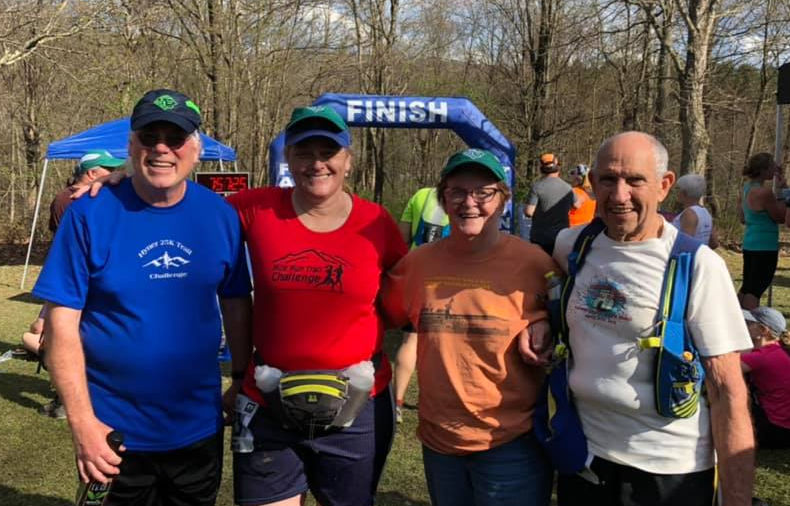
Tania Jacobson: Carl lived life outside of the rules. He ran a weedwacker up and down mountains when most people his age would have been convinced long ago that their time in the mountains was over. He gave the hard advice you didn't necessarily want to hear and snarky words of wisdom if you dared to ask (which I did pretty often -- he always had something unexpected and sarcastic and exactly [the] right to say). And the morning he climbed his last mountain, he joked around with me while buying 3 new pairs of shoes at my shop… because Carl wasn't letting any age dictate what he did with his days.

Jane Kone: When I watched “that man in his 70s” cross the finish line at the Hyner View Trail Challenge in 2010, I never imagined that one day he would become my closest friend.
I knew of Carl Undercoffler back then, but we didn’t actually meet until 2016.
We “ran” our first trail run together on August 7, 2016.
We “ran” our last trail run together, Hyner View Trail Challenge, on April 24, 2021.
Between those two races we shared not only thousands of miles, but thousands of moments — smiles that came easily, laughter that echoed through the woods, stories that carried us up long climbs, life lessons and a friendship I will always treasure.
Thank you, Carl — for the miles, the memories, and the gift of friendship.
Carl was a trail ambassador in every sense of the word — an inspiration, a quiet hero to many, and someone who encouraged others to become more than they believed they could be.

THE WAY HE SHAPED TRAILS AND PEOPLE
Carl’s influence extended far beyond his own running, reaching into the very structure of races themselves, where he contributed as both a race director and course designer [The Dam Scramble], constantly refining and, at times, complicating routes in ways that reflected his understanding of what trail running should be.
He believed, deeply, that trails were not meant to be easy or sanitized, and when he received criticism for smoothing out certain off-camber sections of a course, he responded with humor and honesty, reminding runners that if they had concerns, they were welcome to direct them accordingly, sometimes even pointing out specific individuals in the crowd, much to their surprise.
From my race report about the 2013 Dam Scramble: [Carl stood in front of the runners at the race briefing.] “As I was working on the trails to even out some of the off-camber surface, I was chastised by another trail runner for ruining the race. He said that this person complained that this is supposed to be a trail race — not a stroll on a path,” said Carl.
As he said those words I thought to myself that I wrote something on Carl’s Facebook page that was very similar.
Carl continued. “So if anyone wants to complain about the trails please talk to that guy over there,” then he pointed at me. “His name is Ben Mazur,” and everyone looks at me. What the hell, Carl?! Throw me under the bus! [LOL]
But beneath the humor was a clear philosophy: trail running was meant to challenge, to engage, to demand something from those who chose to take part.
And Carl lived that philosophy fully, not only on race day but in the countless hours spent maintaining trails, often pushing forward through physically demanding work without pause, embodying a level of commitment that inspired both admiration and, at times, exhaustion among those working alongside him.

HE WAS GOING TO BEAT YOU TO THE TOP
There are moments that encapsulate a person so completely that they become legend within a community, and for many, Carl’s ability to outpace runners decades younger than himself was one of those defining traits.
During a Hyner course preview in 2012, standing at the top of the climb notoriously called Humble Hill, I pointed out Carl at the bottom of the mountain to a fellow runner and remarked, half in jest and half in certainty, that despite being 76 years old, he would beat us to the top.
What followed was a steady, determined ascent, and just as predicted, Carl passed us near the upper reaches of the climb near where the trees were cleared to provide the view. Carl moved past us with a consistency and efficiency that seemed to defy expectation.
It was not a fluke.
It was who he was.

THE FINAL ASCENT
On April 24, 2021, I found myself at Hyner View not as a participant, but as an observer, having been sidelined by injury. Seeking a quieter vantage point, I moved away from the main crowd at the lookout and positioned myself along the trail just below the summit, coincidently at that same treeline almost 10 years prior, offering encouragement to runners as they approached the final stretch.
When Carl came through, he was as he had always been. He was focused, steady, moving forward with purpose.
“Ben,” he said, “this hill seems to get longer and higher every year.”
It was a simple observation, delivered with the familiarity of someone who had made that climb more times than most.
I snapped a photo as he continued on.
And just steps from the summit, at the very place where the bell now stands, he fell.
In that moment, on that day, in that place he loved so deeply, his physical journey came to an end yet his soul, spirit and inspiration continues upward to this day.

LET IT RING
So when you reach that top… when your legs are shot and your breath is ragged and the world finally opens up in front of you --
Take a moment.
Put your hand on that rope.
And ring the bell.
Let it carry.
Ring it for yourself. For the climb you just conquered. For the version of you that almost stopped, but didn’t.
But also --
Ring it for Carl.
Let it carry.
For the work he did. For the trails he shaped. For the people he lifted up without ever making it about himself. It carries forward the spirit of a man who gave so much of himself to the trails, to the community, and to the simple, enduring act of putting one foot in front of the other.
Let it echo.
Let it carry.
Let it roll through the valley and climb the ridges and disappear into the sky.
So when you reach the top, and your hand finds that rope, take a moment—not just to celebrate, but to remember.
Ring it.
Let it echo.
Let it carry.
Because in that sound, Carl is still there.
And he’s probably already ahead of you.



Comments