

Dirty Kiln: Mud, Steel, and Something… Else

Canoe Creek State Park isn’t just a place to run—it’s a landscape shaped by industry, scars, and slow recovery. From lime kilns that fed Pittsburgh’s steel boom to bat populations clawing their way back, every mile here carries a story… including the one behind the name “Dirty Kiln.”
My story with Canoe Creek State Park goes back a while. Fourth grade. Early 80s. My dad and I had what were probably the first mountain bikes in Blair County—or at least that’s how it felt at the time. Steel-framed Schwinns. No suspension. Brakes that might work if coerced.
Somewhere up and over the back side of Moore’s Hill, we started a descent that, in hindsight, should’ve come with a warning label. About halfway down, the mud packed so tightly between the fork and tire that the front wheel just… stopped. Locked up. Done.
Every weekend we went out looking for adventure. We found it.
Somewhere up and over the back side of Moore’s Hill, we started a descent that, in hindsight, should’ve come with a warning label. About halfway down, the mud packed so tightly between the fork and tire that the front wheel just… stopped. Locked up. Done. We couldn’t make it another dozen feet with stopping and clearing the mud.
That was probably the beginning of my long, complicated, slightly unhealthy relationship with Canoe Creek.
Dirty from the start.
Before It Was a Park
What most people don’t realize is that a century ago, this wasn’t a quiet place to hike or run. It was busy. Loud. Industrial.
Canoe Creek was once home to:
Two major limestone kiln operations
Multiple mines with a maze of underground passages
A company town with houses, churches, and taverns
A lumber mill, farms, and a grist mill
Several rail lines feeding into the old Petersburg Railroad
This place wasn’t built for recreation. It was built to feed the steel industry.

The Kilns (and Why They Matter)
The geology here is rich in limestone, and in the early 1900s, that made Canoe Creek valuable. Steel mills in Pittsburgh—companies like Carnegie Steel and Jones & Laughlin needed massive amounts of lime. Not for decoration. For survival. Limestone was quarried from the hillsides around Moore’s Hill, then hauled up to massive kilns—some as tall as eight stories.
From there, it was a process that sounds equal parts industrial and slightly unhinged:
Layer limestone. Layer coal or wood. Repeat. Light it on fire.
What came out the other end was quicklime—calcium oxide—a key ingredient in steel production. It acted as a flux, pulling impurities like silica, sulfur, and phosphorus out of molten iron. Without it, steel would be brittle and useless.
So yeah—these quiet trails you’re running? They helped build America’s industrial backbone.

The Remains Are Still There
If you know what you’re looking at, the park is full of ghosts.
The Blair Kilns, built by the Blair Limestone Company (a subsidiary of Jones & Laughlin), are the most visible—massive stone structures near the Environmental Center that still feel imposing today.
Then there are the Hartman Kilns, smaller, rougher, and more hidden along the slopes of Moore’s Hill. Less restored and nearly forgotten.
But it’s not just the kilns. As you move through the park, you’ll start noticing things:
Flat sections of trail that are actually old railroad grades
Rock cuts from quarry operations
Stone foundations tucked into the woods
Embankments where rail lines once ran
Remnants of trestles and loading areas
The Limestone Trail, for example, follows an old rail grade along Mary Ann’s Creek—once part of the Petersburg spur of the Pennsylvania Railroad, which hauled processed lime straight to the steel mills in Pittsburgh.
There was even a line that used a funicular system to haul materials 500 feet up Canoe Mountain to ganister quarries along the ridge.
All of it… gone quiet.
Operations here only lasted a few years—roughly 1907 to 1910—before cheaper transport options made Michigan limestone more economical. And just like that, the industry moved on.
The landscape stayed.

The Wild Things That Stayed (or Came Back)
For all its industrial past, Canoe Creek is now something else entirely. One of the most important things about the park today? Bats. A lot of bats.
The park is designated as a Pennsylvania Important Mammal Area, hosting both summer maternity colonies and winter hibernation sites—including endangered species like the Indiana bat.
In the late 2000s, white-nose syndrome hit. A fungal disease that wakes bats during hibernation, causing them to burn through fat reserves and die before spring. The impact was brutal.
The Frank Felbaum Bat Sanctuary is an old church turned refuge that was once home to the largest nursery colony of little brown bats in the state. On summer evenings, people still gather to watch them emerge at dusk.
Or at least… they used to. In the late 2000s, white-nose syndrome hit. A fungal disease that wakes bats during hibernation, causing them to burn through fat reserves and die before spring. The impact was brutal.
A mine hibernation site dropped from 30,000 bats to 71
The sanctuary lost nearly its entire population—tens of thousands gone
Across Pennsylvania, about 99% of some bat populations were wiped out
Now? There are signs of recovery. Slow. Fragile. But it's real. The winter population has climbed back to around 1,000. Summer colonies are starting to rebuild. It’ll take decades, maybe longer, but they’re hanging on. Which, honestly, feels fitting for this place.
The View You Earn
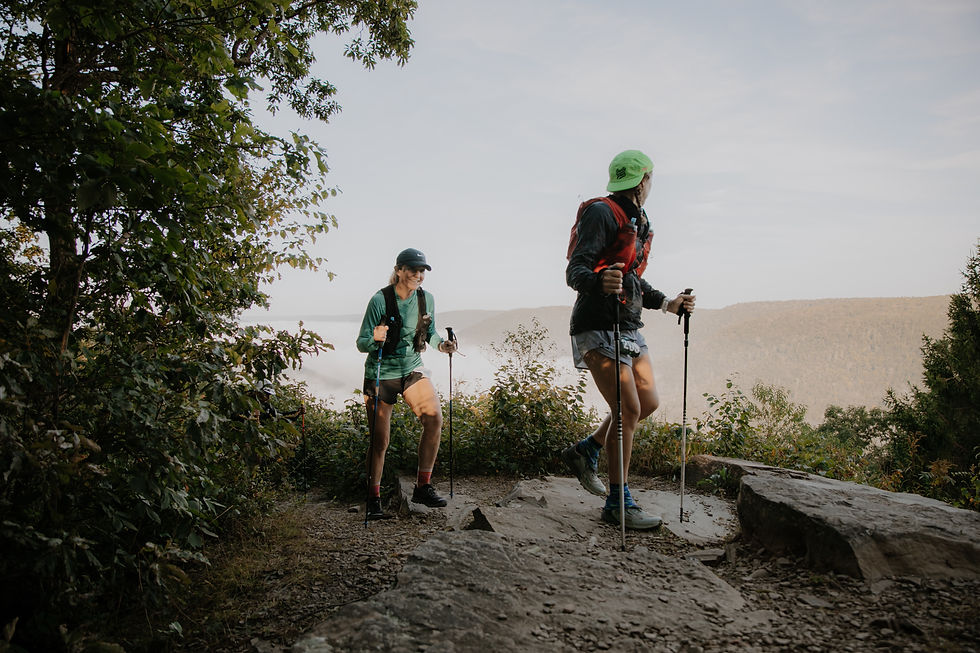
If you’re running the race on the half-marathon course, you’ll eventually grind your way up Hartman Trail. And then it opens up. To your left, the entire Scotch Valley stretches out. Beyond that, Brush Mountain is a long, rolling ridge that runs like a spine through the region. It was once protected by The Nature Conservancy and is still recognized as a major conservation area—one of the more biologically diverse decidiuous forests in the world.
It’s also a highway for soaring birds. And, apparently, glider pilots who ride those same thermals along the ridge. Same terrain. Different ways of moving through it.

So… Why “Dirty Kiln”?
You’d think the name comes from the obvious. Mud. Dirt. Kilns. Done. Logical, right?
Wrong.
Up above the kilns. Quiet. Normal run. He rounds a corner. And there, sitting on a boulder in the quarry… is a completely naked, very confident blonde. Naturally, he stops.
Here’s the real story -- first time it’s being shared publicly: Our co-race director at the time, Ethan Imhoff, was out on the trails one fall evening. Up above the kilns. Quiet. Normal run. He rounds a corner. And there, sitting on a boulder in the quarry… is a completely naked, very confident blonde. Naturally, he stops. Then notices the photographer. Turns out it was a “sexy photoshoot.” Because of course it was. Later, when he’s telling me this story, I had a lot of questions. Most of them starting with “why?”
His answer? “Something dirty.”
And just like that… The name stuck.
Final Thought
Canoe Creek isn’t just a race venue. It’s layers. Industry. Abandonment. Recovery. Weird stories that somehow become permanent. You’ve got limestone caves deep underground. You got steel history under your feet, bats overhead trying to make a comeback, and just enough mud to remind you that this place doesn’t really care how clean you wanted to stay.
It’s rugged. It’s real. And yeah… It’s a little dirty.


Comments