

Worlds End Ultramarathon and Loyalsock: Before the Race, There Was the Place

Updated: May 27
Long before I ever ran then volunteered at the Worlds End Ultramarathon, I was captivated by the Loyalsock. First through faded topographic maps in my grandparents’ basement, then through distant glimpses of mist-covered ridges, and finally through years of returning to the wild heart of Pennsylvania’s Endless Mountains. This is not really a story about a race. It is a story about place and how certain landscapes shape us, humble us, and quietly call us back.

Chapter I: Of Cartography and Calling
“What is this place?”, said 10-year old me.
I stared down at a stack of topographmeic maps in my grandparents’ basement, tracing contour lines with my fingers like they were treasure maps. It was there that I developed my love for cartography. Maps. I loved maps before I even fully understood what they represented. To me, they were portals. Invitations.
Two maps in particular kept pulling me back. One map was the Pine Creek Valley.
The other was also a faded United States Geological Survey map from the 1960s. It showed a gorge carving through a high plateau in the Endless Mountains of Pennsylvania. The creek bent sharply through the folds of the terrain. Tight contour lines dropped away beneath overlooks. Jeep trails disappeared into blank spaces. And then there was the name.
Worlds End.
What kind of place was called Worlds End?

The name sounded less like geography and more like mythology. It carried weight. Mystery. Finality. Why was there such a place hidden away in Pennsylvania? Why did it sound like somewhere a person entered and returned changed?
I didn’t know it then, but I was already being drawn in.
A few years later, when I was maybe twelve or thirteen, I came within a stone’s throw of it. My father had taken me to the Pennsylvania Bowhunters Festival at the Sullivan County Fairgrounds. Somehow, once again, I got my hands on a map. This one was a state park map, and once again I was completely enthralled.
High Rock. Butternut. Pioneer Road. Loyalsock.
Even the trail names sounded from a forgotten time.
I remember standing there thinking, I have to go there.
But I didn’t.
Instead, I spent the weekend shooting archery targets with my father while stealing glances toward the mountains rising beyond the fairgrounds. I can still picture the mist lifting from the gorge walls in slow spirals, drifting through the hemlocks like smoke from some hidden world.
So close. Yet impossibly far away.
Years later, after college, I tried to make it in Manhattan working as a video editor. It turns out the romantic vision of “making it in the city” loses some shine when you need three jobs just to survive. Eventually, exhausted and broke, I moved back to Pennsylvania and settled in State College to work in video production.
During that first year, before I had really built a community, I drove. Constantly. Long drives through back roads and forgotten valleys. I wanted distance from campus life since I felt as a graduate that I "was above it". The farther out into the country I drove, the more I felt myself returning to something steadier.
One afternoon, I finally made it to the entrance of Worlds End State Park.
And then I turned around.
The day was getting late. I had hours left to drive. Practicality won.
But even now, it feels too strange not to admit: as I pulled away, I could have sworn something inside me said, You’ll be back.
Driving home, I stopped at Pier 87 for dinner and asked the waitress a question that had been bothering me for years.
“What do you call this place?”
She looked confused. “What do you mean?”
“This area. Is it a Native American word? How do you pronounce it? Low-Lay-Sow-Key?”
“It’s Loyal-Sock,” she answered carefully, probably wondering if I had recently escaped from somewhere.

Loyalsock.
The word comes from Lawi-Saquick, often translated as “Middle Creek.” Indigenous people gave it that name because the creek lies between Muncy Creek and Lycoming Creek. Early settlers described the northern reaches of the region as “wholly uninhabited and wild.”
That word stayed with me.
Wild.
Not empty. Not forgotten. Wild.
Then, in 2016, I signed up for the second running of the Worlds End Ultramarathon 100K.
I am not comparing myself to astronauts or explorers. But I can say this honestly: the moment I stepped out of my car at Worlds End for the first time, something radiated up from my feet and changed in me forever.
Not because of the race.
Because of the place.

Chapter II: The Race Inside the Wilderness
My first Worlds End Ultramarathon was simultaneously my worst race and best race.
The night before, I slept in the back of a Mazda 3 hatchback in the state park parking lot. Or, more accurately, I attempted to sleep. (And before anyone gets ideas: this is no longer permitted, so maybe don’t try recreating my terrible decisions.)
Sometime in the early morning, I noticed a suspicious amount of activity outside the car. Doors slamming. Voices. Headlamps moving around.
“Why are people awake so early?”
I ignored it and tried to go back to sleep for what felt like an hour before finally checking my watch.
The race started in ten minutes!
What followed was one of the least graceful pre-race preparations in ultrarunning history. Changing clothes inside a Mazda hatchback should qualify as a mobility exercise. I sprinted to the starting line carrying gear in my teeth, launched my drop bags into a random pile, and skidded to a stop beside my friend Joel.
“Where have you been?” he asked.
“I was—”
The race started before I could answer.
The adrenaline carried me through the opening miles. Until it didn’t.
By mile ten, I was unraveling.

What followed was a long, miserable death march through one of the most beautiful places I had ever seen. Especially after Devils Playground, I felt like I was moving underwater. Every climb became existential. Every descent felt hostile.
At Coal Mine Aid Station, I committed the cardinal ultrarunning sin.
I sat down.
The Chair.
Veterans know once you enter the gravitational pull of an aid station chair, your race can disappear into another dimension.
Then Kathy arrived.
My friend Kathy is one of those relentlessly cheerful runners who somehow appears energized despite surrounded by human suffering. The type of person who sings while climbing mountains. I hated that.
She convinced me to leave the death chair and head toward High Knob together.
For miles, my strategy consisted of running ten steps, walking twenty or sixty, and questioning every choice that led me there. Kathy remained patient through all of it, though I later learned she was apparently very close to abandoning me somewhere deep in the wilderness.
Then something happened at High Knob.
I still can’t fully explain it.
Maybe it was calories. Maybe it was rest. Maybe something in my brain simply reset. But somewhere between exhaustion and surrender, I came back to life.
I launched out of the aid station and bombed downhill toward the Dry Run Ranger Station like a completely different person. Halfway down the descent, I passed Kathy.
“I feel amazing, Kathy! See ya!” I felt her eyes drill into the back of my head.
For the rest of the race, I moved like someone possessed. Between Dry Run and Brunnerdale, I reeled in runners who had passed me hours earlier. Each one looked at me with complete confusion.

Honestly, I understood why. I was someone else.
The second half of the race went by faster than the first... a rare feat for such a beast of a course. I finished in 17 hours and 40 minutes.
But strangely, the race itself is not what stayed with me most.
It was the landscape.
The sudden reveal of Alpine Falls descending into Big Run. The tannin-dark wetlands near Sones Pond. The impossibly soft trail beneath the pines after Iron Bridge. The rock gardens folding into the gorge. High Rock. Canyon Vista. High Knob. Alpine View.
And the water.
Rode Falls. Angel Falls. Dry Run. Double Run. Mineral Springs.
The wilderness felt ancient and enduring in a way that made the race itself seem temporary. We runners arrived in a blur of headlamps, sweat, panic, jokes, split times, and aid station chaos.
But the Loyalsock remained.
Patient.
Indifferent.
Beautiful.

Over the last decade running, then volunteering, there have been endless stories surrounding the race.
The 2020 “End of the World” theme accidentally predicting COVID then later that year a truck carrying diseased laboratory monkeys crashed a few miles from David’s house.
Aid station banners secretly referencing taverns from the Edgar Wright film The World’s End.
The year David hiked the Appalachian Trail and accidentally handed most day-to-day pre-race management duties to me.
The ongoing meme war where David is now constantly mistaken for Adam Driver while runners distributed temporary tattoos of my face like some deeply misaligned form of hero worship.
Thomas McNerney on logistics somehow possessing both the best and worst luck at all times while solving every catastrophe through pure brute force.
Tornadoes. Mud. Waterlogged trails. Shoe repairs held together with duct tape and faith.
High Knob Vista becoming a "Dirt Church" for a wedding between two runners, to spreading ones ashes... all in the middle of a race.
Late-night pre-race conversations that somehow become more meaningful every year.
A runner answering a phone call mid-race because her husband couldn’t find the hammer at home.
Participants disappearing off course without telling anyone. Runners napping trailside and getting poked with sticks by concerned strangers. Frenchmen sternly informing us that “we don’t really have steep cutoffs like this in Europe.”
All of it mattered.
And none of it mattered.
Because once again, the race itself was only temporary.
The place was the constant.

Chapter III: Here Lies the Loyalsock
Here lies the Loyalsock.
From the moment I first stepped into your wilderness, before I had even left the parking lot, I knew you were different.
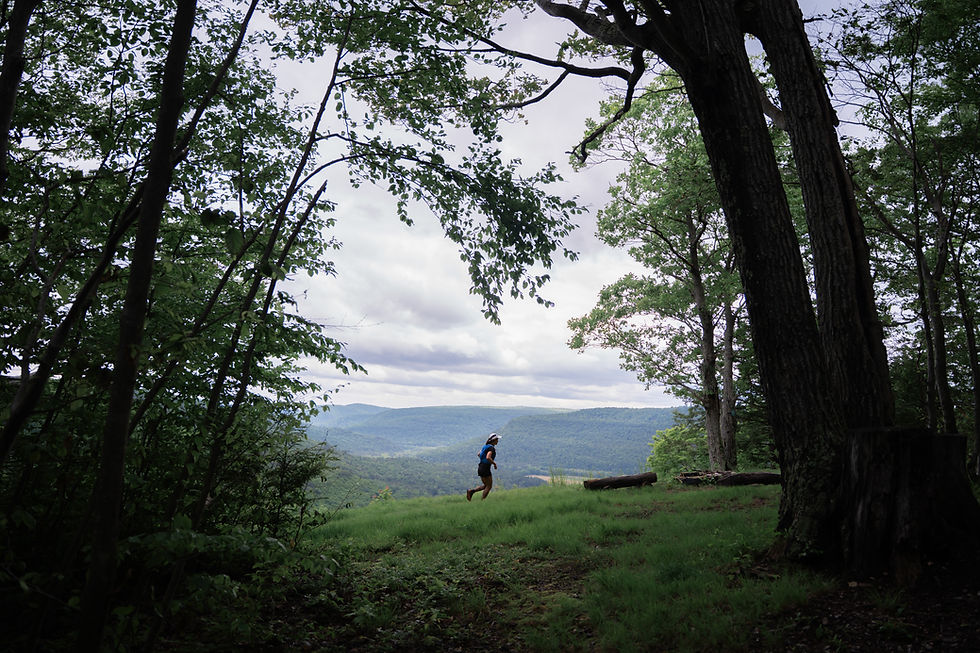
The scent of pine needles warming in the sun. The endless murmur of Loyalsock Creek slipping over stone. The ridges stacked into blue distance. The feeling that around every bend waited something undiscovered.
You were never simply a place on a map.
You were the map.
You became the compass point pulling me back again and again.
Your forests have heard our footsteps in every season. Your rock cities became our playgrounds. Your waterfalls became sanctuaries. And every year, when the Worlds End Ultramarathon returns, these mountains become something more than wilderness.
They become a gathering place.
A proving ground.
A homecoming.
What I didn’t understand as a nerdy teen staring at contour lines in a basement was that places can shape people. Over time, they carve into us just as surely as water carves through stone.
Something that began nearly forty years ago and fully awakened ten years ago now runs through me like blood.
It is here, in these woods, that I found my tribe.
And I, and we owe you more than we can ever repay.

We arrive carrying tired legs, anxious minds, fractured confidence, and all the invisible weight of ordinary life. And somehow, through mud and climbs and rain and exhaustion, we return with something greater.
Perspective.
Belonging.
Wonder.
Some arrive as strangers and leave with lifelong friendships. Some come searching for challenge and discover purpose instead. Some leave pieces of themselves behind here willingly.
And some of us never really leave at all.
To those coming here for the first time this weekend, understand this:
Worlds End Ultramarathon is not merely a race.
It is an invitation.
A calling.
A confrontation with something larger than yourself.
And maybe, if you let it, the beginning of a lifelong relationship with wild places.
Here, in the land of the Middle Creek, lies the Loyalsock.
And it has shaped us.
That is why, no matter how many times we leave, we will always run back.

Comments