

Don't Be Afraid of the Dark: Eastern States BLACKOUT

Sooner or later, every ultrarunner finds themselves staring into the beam of a headlamp, wondering what waits beyond the next bend in the trail. In this edition of Rocksylvania Dispatch, I explore why darkness feels so unsettling, how runners can safely and confidently embrace night running, and why some of the most memorable miles happen after sunset. Along the way, I'll introduce Eastern States: BLACKOUT: a unique overnight training camp designed to remove the mystery from the nighttime sections of the Eastern States 100 by turning fear of the unknown into familiarity with the trail.

Don't Be Afraid of the Dark
There comes a time in nearly every ultrarunner's life when they arrive at a simple, unavoidable realization:
I am going to be running in the dark.
Maybe it happens while studying a race profile. Maybe it's when you realize sunset arrives several hours before your expected finish. Maybe it's during training when work, family, and life leave you with no other option but to lace up after sundown (or in the wee morning hours).
For me, darkness arrived early.
My second trail race was a little 10K near Mifflinburg, Pennsylvania called Night Flight. If the name wasn't a clue, the fact that it started after sunset probably should have been. Looking back, I was introduced to night running almost immediately after discovering trail running itself.
Then, mostly out of necessity, I kept doing it. Many of my early races either started or finished in darkness. Training for spring ultras meant weekday runs before sunrise or after work. If you hold a full-time job and have ambitions beyond the marathon distance, eventually you become acquainted with a headlamp.
Yet despite how common it is, darkness remains unsettling for many people. Why? What is it about the dark that makes otherwise rational adults suddenly question every sound in the woods?
I've always found that interesting because I've never been particularly bothered by it.
Part of that may stem from my fascination with what historians call the "Second Sleep" theory. Before electric lighting became commonplace, many people apparently didn't sleep straight through the night. Instead, they slept for several hours, woke naturally around midnight, spent an hour or two reading, talking, praying, or tending household tasks, and then returned to bed for a second sleep until dawn.
In other words, being awake at night wasn't unusual. It was simply part of life.
Somewhere along the way, darkness transformed from a normal part of the human experience into something we actively avoid. We flood our homes, streets, and screens with artificial light. We spend very little time in genuine darkness. Then, when we're finally confronted with it, our brains start manufacturing problems.
Every snapping twig becomes a predator. Every pair of reflective eyes becomes a monster. Every shadow becomes something worth worrying about.
The funny thing is that the woods themselves haven't changed. The same trees, rocks, and trails that felt welcoming at noon are still there at midnight. What changes is our perception. And perception matters.
At Eastern States 100, many runners spend more than half their race in darkness. The Pennsylvania Wilds become an entirely different place after sunset. Distances feel longer. Navigation becomes more deliberate. Climbs seem steeper. Solitude feels deeper.
For some runners, the night becomes the hardest part of the race—not because of the terrain, but because of the uncertainty.
That's exactly why we created Eastern States: BLACKOUT.

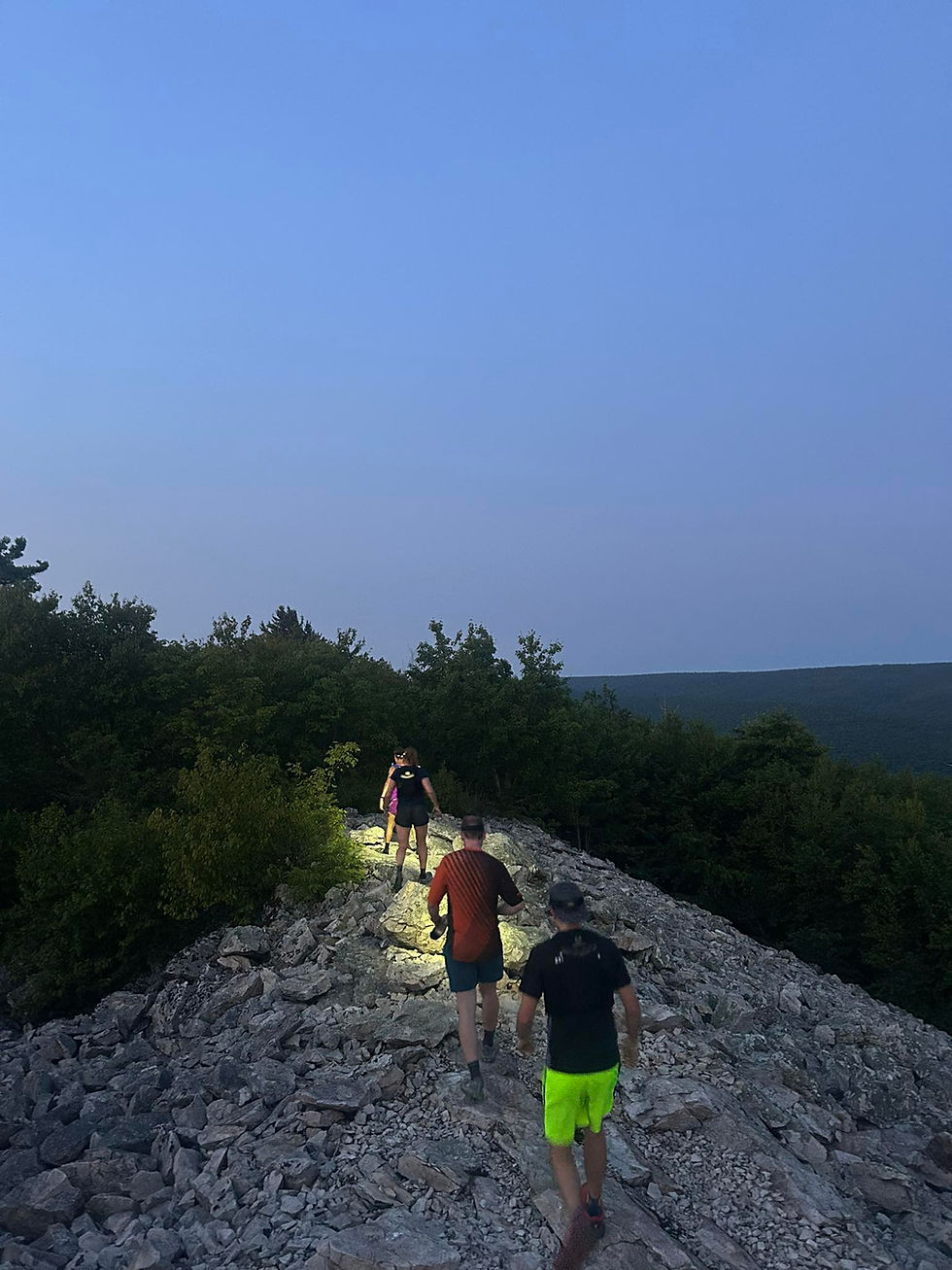
BLACKOUT is a focused, immersive running camp designed to remove the mystery, and the fear, of the night sections of the Eastern States 100. Rather than simply talking about night running, participants experience it repeatedly, intentionally, and under conditions that closely mirror race day.
Over three nights, runners will tackle three distinct sections of the ES100 course entirely under the cover of darkness. These are not novelty runs. They are purposeful previews of some of the race's most demanding nighttime terrain, where navigation, pacing, fueling, and mental resilience become just as important as physical fitness.
Headlamp management, trail awareness, and decision-making in limited visibility are all sharpened through experience rather than theory.
The routes have been selected to replicate the realities of Eastern States: long stretches between aid, sustained climbs, technical descents, and the quiet isolation that defines the race after sunset. By confronting these sections in a supportive environment, runners gain something invaluable before race day: familiarity. And familiarity breeds confidence.
Between runs, participants will stay in rustic lodging that encourages recovery and camaraderie. Hearty breakfasts and dinners provide fuel for both body and conversation. Stories get exchanged. Lessons get learned. Friendships get formed.
Daylight hours remain intentionally flexible. Runners can rest, stretch, nap, or take advantage of optional activities such as kayaking, biking, golf, informal discussions, or simply sitting around a campfire watching the Pennsylvania Wilds transition back toward darkness. Because recovery is part of training.
BLACKOUT isn't about proving how tough you are. It isn't about suffering for suffering's sake. It's about preparation.
It's about transforming unknown miles into familiar miles. It's about replacing anxiety with understanding.
Most importantly, it's about stepping onto the starting line of Eastern States knowing you've already experienced some of the course's darkest hours.
So I'll ask the same question I always do: Why be afraid of the dark?

Embracing the Dark: A Trail Runner's Guide to Night Running
For many trail runners, night running starts as a necessity. Maybe you're training for a 100-miler, squeezing in miles after work, or simply got caught out longer than expected. Eventually, though, something changes. The darkness stops feeling intimidating and starts feeling magical.
The woods become quieter. Your world shrinks to the small circle of light in front of you. Every rustling leaf sounds important. Every familiar trail feels brand new.
Running at night is a skill like any other. It takes practice, preparation, and a willingness to be a little uncomfortable at first. Here are some tips to help make the experience safer, more enjoyable, and maybe even something you look forward to.
Light Is Life
If there is one piece of advice that matters most, it's this: don't skimp on lighting.
Modern headlamps are remarkably good. For most trail running, a light producing 300 lumens or more will provide comfortable visibility. Pay attention to battery life, recharge options, and overall comfort. A headlamp that bounces around on your forehead for four hours will quickly become irritating.
Even better than one light is two.
A combination of a headlamp and a waist-mounted or chest-mounted light dramatically improves visibility. The headlamp follows your eyes and illuminates trail markers and upcoming turns. The waist light creates shadows behind rocks, roots, and uneven terrain, making it easier to judge depth and foot placement.
Always know how long your batteries will last and carry a backup light for longer adventures. Batteries have an uncanny ability to die at the exact moment you stop paying attention to them.
And if you're running with friends, be considerate. Nothing says "I value our friendship" quite like not blasting 1,000 lumens directly into their retinas during a conversation.

Slow Down and Stay Upright
The darkness changes everything.
Your depth perception isn't as sharp. Your peripheral vision becomes limited. Obstacles seem to appear later than they would during daylight.
As a result, expect your pace to slow.
This is completely normal.
Instead of focusing on pace, focus on effort and efficiency. Look several feet ahead on the trail rather than directly at your feet. Your brain needs time to process obstacles and choose a safe line.
When trails become rocky or root-filled, shorten your stride slightly and consciously lift your feet a little higher. Most night-running mishaps aren't dramatic wildlife encounters, they're stubbed toes, rolled ankles, and face-first meetings with tree roots.
A small reduction in pace is much cheaper than a trip to urgent care.
Run Familiar Trails First
Trails look completely different after dark.
That obvious turn you never miss during daylight? Somehow invisible at night.
That distinctive rock formation you've used as a landmark for years? It now resembles every other rock on the mountain.
If you're new to night running, start on routes you know extremely well. Familiarity reduces stress and allows you to focus on adapting to the darkness rather than worrying about navigation.
Once your confidence grows, you can start exploring farther from your comfort zone.
Leave One Ear Open to the Woods
Night running is one of the few opportunities we get to fully experience the trail environment.
The woods communicate constantly. Running water, wind, wildlife, and even your running partners provide useful information.
For that reason, it's generally best to skip the headphones. At minimum, keep one ear open. Your hearing becomes an important tool at night. You'll be better able to stay connected with your surroundings, detect approaching cyclists or runners, and avoid startling wildlife.

Dress for the Temperature You Haven't Felt Yet
One of the biggest mistakes runners make is dressing for current conditions instead of future conditions.
The temperature at sunset is not the temperature you'll experience at midnight.
Even after a warm day, temperatures can plummet once the sun disappears. Wind that felt refreshing during daylight can become surprisingly uncomfortable after dark.
Think layers.
A lightweight wind shell, rain jacket, gloves, hat, or thin insulating layer can make a tremendous difference if conditions change unexpectedly.
Similarly, carry a little more fuel than you think you'll need. Your body burns additional energy staying warm, and unexpected delays are more consequential at night.
A little extra preparation buys a lot of confidence.
Tell Someone Where You're Going
Night running isn't inherently dangerous, but mistakes tend to have larger consequences after dark.
Always let someone know:
Where you're running
Your planned route
When you expect to return
Carry a phone, but don't rely on it as your emergency plan. Dead batteries, lack of service, and accidental damage happen.
Technology is a helpful backup. Preparation is the real safety system.
Understand the Wildlife Situation
Many runners worry about animals at night.
In reality, most wildlife encounters are anticlimactic.
Foxes, skunks, raccoons, deer, and coyotes usually hear you long before you see them. Most will disappear before you even realize they were nearby. Occasionally you'll spot glowing eyes reflecting your headlamp from the woods. More often than not, the terrifying beast lurking in the darkness turns out to be a curious deer.
If you do encounter a larger animal, stay calm. Face the animal, shine your light toward it, make yourself appear larger, and slowly back away while creating distance.
Don't Let Your Imagination Run Faster Than You Do
Every experienced night runner has had that moment.
You hear a noise.
Then another.
Suddenly you're convinced something is stalking you through the forest.
In reality, it's usually a squirrel.
Or a rabbit.
Or a branch moving in the wind.
Darkness amplifies imagination. That's part of its charm and part of its challenge.
The woods aren't necessarily different at night. You're just experiencing them with less information. Accept that your brain may occasionally manufacture monsters where none exist and keep moving forward.
Embrace the Experience
Night running isn't simply daytime running with a headlamp.
It's its own thing.
The darkness forces you to focus. It strips away distractions. It slows you down and encourages you to pay attention.
You stop worrying about pace and start noticing things you would otherwise miss—the rhythm of your footsteps, the sounds of the forest, the stars overhead, the feeling of moving confidently through terrain that once seemed intimidating. Some of the best memories in trail running happen after the sun goes down.
The trick is getting out there often enough to discover that for yourself.
Why BLACKOUT Exists
All of those tips like using proper lighting, slowing down a little, learning to trust your footing, dressing for changing temperatures, understanding wildlife, and most importantly, getting comfortable with the psychological side of darkness all lead to the same conclusion:
The best way to become comfortable running at night is to run at night. There is no shortcut.
You can read articles, watch videos, listen to podcasts, and absorb every piece of advice available, but eventually you have to click on the headlamp, step beyond the reach of the parking lot lights, and discover that the darkness is not nearly as intimidating as your imagination convinced you it would be.
That realization is exactly why Eastern States: BLACKOUT was created.
The purpose of BLACKOUT is not simply to log miles after sunset. It is to transform uncertainty into familiarity. During the weekend, participants will experience three distinct sections of the Eastern States 100 course entirely at night. Each route was carefully selected to expose runners to the unique challenges they will face during the race itself—technical footing, long climbs, navigation decisions, isolation, and the mental games that often begin once daylight fades.
By the end of the weekend, those sections will no longer be unknown. The landmarks, terrain, and character of the course will become familiar. The darkness will become less mysterious. The confidence gained from that familiarity can be one of the most valuable pieces of preparation a runner carries to the starting line.
Because the truth is that Eastern States doesn't become harder when the sun goes down. It simply becomes different.
The trails are still there. The rocks are still there. The climbs are still there.
The only thing that changes is your perception of them.
BLACKOUT is designed to help runners bridge that gap: to learn that the dark is not something to fear, but simply another condition to prepare for and embrace.
We would also like to extend our sincere thanks to our sponsor, the company behind the iconic headlamps trusted by trail runners around the world, Petzl, for helping support this unique training experience and for helping runners safely explore what lies beyond the beam of their headlamp.
After all, why be afraid of the dark?
Eastern States: BLACKOUT
Where the Wilds Get Even Wilder.


Comments